

Lead Analyst: Mary Allen, InsightaaS & JSA
Contributors: Jay Dietrich, Uptime Institute; Miranda Gardiner, The iMasons Climate Accord; Andy Lawrence, Uptime Institute; Ehsan Nasr, Microsoft; Shaolei Ren, University of California; Francois Sterin, Data4
This chapter is excerpted from Greener Data: Volume Three, launched on Earth Day 2026. Featuring perspectives from 75+ sustainability leaders across the digital infrastructure ecosystem, the full book is available now on Amazon.
Across the globe, an impressive number of countries, cities, companies, and other institutions have pledged to achieve net zero carbon emissions,1 committing to the action plans needed to address the looming climate crisis. In that effort, certain sectors stand out as leaders with the tools and collective will that can drive change. The ICT sector is a prime example; over recent decades, it has maintained a consistent carbon footprint that is approximately 2% to 4% percent of the total emission2 – similar to the airline industry – while simultaneously experiencing substantial growth, enabling it to deliver social and economic benefit, including platforms to solve sustainability challenges in other spheres of activity. According to researchers in the Global enabling Sustainability Initiative (GeSI), digital solutions in several areas have the potential to reduce global emissions by 20% by 2030, decoupling long-held assumptions about the relationship between growth in productivity and carbon dioxide equivalent (CO2e) emissions. In this forecast, researchers have argued that ICT-enabled emissions reductions in other sectors are tenfold the impact of ICT itself.3
By 2030, ICT will provide benefits across the triple bottom line, reducing CO2e and resource use, generating additional revenues, cost savings, as well as wider societal benefits. In the figure below, GeSI estimates for ICT’s carbon abatement potential in various sectors for select regions demonstrate the opportunity for ICT-enabled progress on sustainability.
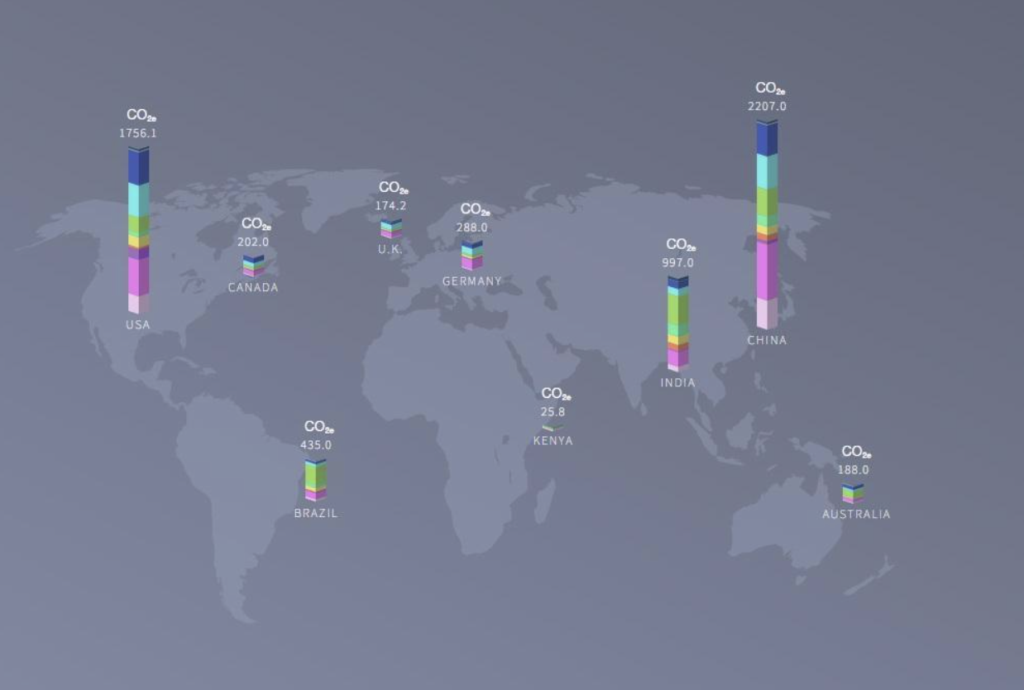
Figure: GeSI estimates for ICT-enabled carbon emissions abatement by 2030. // Source: Global e-Sustainability Initiative.
Within ICT, the data center industry is emerging as a distinct sector central to the digital transformation that is reshaping business and society. Our increasing reliance on digital infrastructure is evident in the phenomenal growth in demand for data center processing and storage, and overall capacity. A consequence of this growth is increased energy consumption to power new, larger, and more dense data center facilities, a key input to the sector’s carbon emissions, now estimated at approximately 1% of the global total energy-related emissions.4 In the last decade (2005-2017), innovation to drive efficiency in IT equipment and facilities design has offset potential electricity consumption associated with new data center build.5 Over this period, electricity consumption remained relatively flat despite significant capacity increases,6 as leaders in the data center world worked to support ambitious sustainability goals. The industry has emerged as a model for other carbon intensive sectors through efficiency innovation, significant acquisition of renewable energy capacity, and the commitment by many market leaders to Science Based Targets Initiative (SBTi), and other initiatives aimed at improving social and environmental performance. Going forward, the ingenuity that the data center industry has demonstrated in the ongoing search for ever greater levels of efficiency will become increasingly critical. Innovation resides in the sector’s DNA and if applied to sustainability issues, it may support ongoing leadership for the sector in climate struggles.
Robust industry response to the environmental crisis is urgent now, as we face a tsunami of emerging challenges. At a state level, existing national action plans developed to realize commitments to the Paris Agreement on global warming have fallen short of requirements to manage global temperature increases.7 While the gap between promise and outcome urges more effective action on the part of governments and the private sector, political winds have brought retreat in key quarters. Most notable are the recent US withdrawal from the Paris Agreement and renewed support for fossil fuels.8 On the regulatory front, the relaxation of measures to prescribe climate disclosure and reporting by the SEC in the US9 has been followed in Canada as securities regulators pushed pause on work to develop key sustainability reporting initiatives, including a new mandatory climate-related disclosure rule.10 A regional leader in environmental policy, the EU has also recently relaxed requirements for environmental reporting for many businesses.11 Meanwhile, global tariff wars are expected to reduce access to low-cost Asian clean energy technologies.12 At a business level, these shifts in policy and regulatory regime threaten to upend organizational priorities as economic and national security perspectives cloud out environmental discourse.
Against this backdrop, discrete issues are surfacing for the data center industry as physical and organizational challenges stretch the ability of owners, operators, and consumers of data center services to drive further advance on sustainability. Located at the intersection of trends towards digitization and decarbonization, the industry will need to draw deep on innovation reserves to balance the mounting opportunity to capture the explosive expansion of demand for data center services and the need to participate in climate protection efforts.
Will IT innovation test or support the data center industry’s leadership role in sustainability? Wider adoption of data processing applications, such as data science and AI specifically, but including crypto mining and IoT, has potential to set the IT industry’s environmental footprint on a new trajectory.
A recent International Energy Agency (IEA) report projects that electricity demand from data centers on a global basis will more than double by 2030 to approximately 945 terawatt-hours (the entire electricity consumption of Japan), driven in large part by AI, while power demand from AI-optimized data centres will more than quadruple by the same year.13 Growing energy usage has it corollary in increased carbon emissions. When generated through the burning of fossil fuels, electricity production releases CO2; as consumers of electricity, data centers are responsible for the carbon impact of growing operations.
Translating this relationship to the impact of advanced applications, a study from 2021 estimated that the training of one machine learning algorithm for natural language processing, for example, would result in 284,019 kg of CO2e emitted – roughly five times the lifetime emissions of a car.14 Since then, the surge in use of applications such as generative AI and other AI engines and tools as mainstream technology in the business community,15 is pushing data services requirements, data center build, and energy consumption/carbon emissions in this sector.
Is it possible to square the circle? To continue to support industry growth in a sustainable way? While a first step in emissions reduction is to drive efficiencies that can reduce energy consumption, for many industry observers, the answer lies in the electricity grid – in bridging the gap between clean energy demand and supply by encouraging more production and consumption of carbon-free energy. The emissions factor of the grid is a determining factor in the data center’s environmental footprint, as the facility may located in regions such as the Nordics that are powered by clean energy, or a region that continues to rely on fossil fuel-based power, such as China. While data center innovators are becoming more transactive, building more clean energy resources onsite to support local operations or grid interactivity, most facilities continue to rely on grid power. Happily, in some jurisdictions, grid power is green, as Figure 2 shows. Unhappily, with some exceptions – Canada, Ireland, Germany, Australia, the Nordics – these regions are not home to the most active data center markets. An ecosystem approach, where data centers encourage further grid decarbonization in market hubs, in particular, will be critical to efforts to drive sustainability, but challenging as grid operators wrestle with aging infrastructure, the need to maintain grid stability through the introduction of renewables, and demand increases associated with data center activity and the electrification of other industries (ex. EVs).
The Industry Faces Organizational Challenges
Beyond the grid, as they look to maintain sustainability leadership, data center operators face new challenges to improved environmental performance. With vacancy rates at an all-time low, demand high, and the increasing participation of a new wave of institutional investors, singular focus on the creation of new capacity can be expected. Motivating technology companies/data center operators to prioritize sustainability will involve addressing key issues:
New Thinking – ‘Data Center Plus’
In the race to build more capacity, data centers may act like ‘dumb’ consumers of energy. To address power shortages due to grid inability to keep pace with the rapid advance of data center construction, a BYOP (Bring Your Own Power) movement is emerging, which involves the use of onsite generators to support primary power delivery. While standby diesel generators are intended to power the data center in emergencies for short stretches only (100 hours per year or less due to onsite storage and air quality permitting challenges), with better supply, natural gas fueled turbines appear a more ready and reliable option for operators that are anxious to come online. The xAI supercomputer in Memphis, Tennessee, which relies on unpermitted mobile gas generators represents an extreme example.16 With less carbon impact than other fossil fuels, natural gas is widely recognized as a ‘bridge’ solution to data center energy challenges. But this temporary solution also represents a step backwards from a sustainability perspective, which highlights the gap in planning for future energy capacity needs. Planning two-to-three years out in isolation from a broader data center ecosystem suggests marginal optimization of operations, and neglect of the potential in grid decarbonization. To change this paradigm, a long-term program that recognizes the data center as critical social infrastructure is needed. Planning for a 50-year span will encourage businesses to think about operations as “data center plus energy.”
Transparency – Inside and Out
A data center’s sustainability profile is composed of many elements that may not sum to optimal. For example, a facility may claim to be ‘water positive’; a 2024 report on US data center energy consumption from Lawrence Berkeley National Lab found that while water usage was up on an industry basis (from 21.2 billion liters of water consumed in 2014 to 66-billion-liter in 2023), water efficiency improvements, in enterprise facilities in particular, resulted in a WUE of just over 0.36 L/kWh through 2023 despite increased usage in the hyperscale businesses sector.17 Or, it may boast ‘zero emissions at the market level’ – and for market consumption – but run an emissions factor of .5 MT (million metric tons) of CO2 on every megawatt hour of energy consumed. Similarly, a service provider may have highly efficient infrastructure, while running at the average utilization rate of 20-30% for IT infrastructure rather than an optimal average level of 40-50%, resulting in underutilization of capacity and waste of energy, space, power and cooling resources. In colocation environments, the carbon impact of IT infrastructure is often relegated to tenants and hence excluded from carbon neutral calculations for the facility as a whole. To work aggressively on the carbon emissions factor – based on a calculation of energy consumed at the meter, not offset by RECs – data centers will need to engage in open discussions about data center performance, tackling a historical lack of communication between IT and facilities management and other stakeholders in the data center ecosystem.
IT Efficiency Matters
In traditional measures of data center sustainability, ex. Power Usage Effectiveness (PUE), focus is placed on measuring energy consumption from a facilities perspective. Embedded carbon created in hardware manufacture can be overlooked, while system performance can be neglected as the actual work delivered by IT operations is not factored into calculations. Depending on data center design, size, cooling system efficiency, and IT infrastructure utilization, however, server, storage, and networking equipment may consume more power than facilities – 50% or more. Improving IT efficiency and optimizing utilization throughout the IT hardware stack is critical to reducing overall energy consumption and increasing the work delivered per unit of energy consumed.
Operating emissions can be minimized through a variety of techniques, including the use of more carbon-free energy, disciplined operation of the facilities infrastructure, strong focus on increasing the utilization of the IT infrastructure, right sizing server configurations for the workload, and the deployment of power management where this is compatible with workloads.
The environmental footprint of a data center also includes the embedded emissions in the building infrastructure, which is set based on new build material choices and construction processes, and the emissions associated with the manufacture of IT equipment. A lifecycle view that considers IT and facilities emissions impact in the design and build phases will support a truer environmental assessment that is foundational to improvements in sustainability performance.
Metrics Matter
Evaluating and improving the technical performance of IT and mechanical, electrical, and plumbing (MEP) equipment is the means, but not necessarily a validation of progress on sustainability. For this, the industry relies on a complex set of metrics that are used variously to demonstrate progress in different reporting structures. For data center managers, and large consumers of energy and equipment in particular, the carbon metric system is very confusing; there are many metrics, lots of scopes, different ways of measuring these, and different inputs, for example, Scope 2 market-based emissions and location-based emissions.
Scope 3 is especially challenging as data resides in the supply chain, the supply chain may be two to five layers deep, and embedded emissions data is typically provided for an average, rather than purchased, product. It is also nearly impossible to know what, if any, emissions offsets were used by the suppliers. Confusion around equivalencies, and other issues, mean that Scope 3 embedded emissions estimates have a high degree of uncertainty, with accuracy rates ranging in most cases from 30-70%, depending on assumptions. This system is difficult to navigate, to validate, and vulnerable to those who might want to game the system. To ensure accountability and incentivize more action, standardized and accurate reporting systems are critical.
Other metrics – ex. the public health impacts of data centers at a local level – may also work to encourage investment in cleaner operation and a warmer welcome at regional levels.18
Business Case Boondoggle
More transparent and more holistic insight into environmental impacts may help spur data center action on sustainability, but this insight and action must support a business case that aligns with organizational or corporate goals. For example, a ‘work per energy’ metric that would focus on reducing energy use and provide a transparent assessment of data center performance may help establish the benefits of action on sustainability. Developing a better valuation of carbon emissions, where carbon cost is converted into currency cost, is another approach that would enable operators to work out a useful cost-benefit analysis. Today, there is carbon pricing in compliance markets (typically $50-100 per ton of emissions), but in voluntary markets, pricing is close to zero. As a result, companies gain access to carbon credits from voluntary markets at minimal cost, while still claiming to be ‘green.’ Pricing that accounts for the social cost of carbon changes by orders of magnitude across administrations ($1-200 per ton), a range that defers real, objective action on sustainability. As with carbon, so too with water, which currently commands a very low valuation. While water resources represent an increasingly important resource in data center operation, efforts to create a recognized valuation framework for water,19 remain in their infancy.
Training Divide
As computer science and engineering programs across the globe graduate new cohorts of engineering professionals, many leading academic institutions have built comprehensive and forward-thinking degree programs that focus on sustainability management. But do these intersect at an institutional level? Or must learners rely on individual initiative to develop expertise in both data center design/operation and sustainability? Skills training and upgrade are offered to data center professionals by various academic and industry groups,20 but focus on sustainability is just emerging. Today, the Uptime Institute offers training and certification for sustainability professionals, a new National Data Centre Academy in the UK offers a program steeped in green topics, and a new Certificate in Global Digital Infrastructure offered by UC Berkeley includes “the environment” in a very long list of curriculum components.21 More of these training initiatives would be welcome: a recent Canadian survey of tech workers found that only 15% of respondents had received any training on the topic of sustainable ICT, and not enough to take meaningful action.22
Growth in industry capacity and complexity is dictating the need for more, and more specialized data center professionals. Due to AI and other process-intensive applications, the data center industry’s energy consumption has increased in recent years on a scale not seen before. To address these looming energy challenges, education that enables young IT professionals – and power system engineers in particular – to provide thought leadership on this issue will be needed.
Industry Collaboration to Bridge the Gaps
Climate crisis, combined with explosive data center growth, is pushing the dial on these industry challenges from persistent to perilous. But across the industry, many different kinds of organizations are stepping up, filling the cracks that delay action on sustainability through collaboration, innovation, and the sharing of knowledge and business/operational best practices.
Public Pledge
By securing the commitment of large numbers of key market players to work together to create standardization in carbon accounting and to reduce emissions from digital infrastructure, industry groups such as the iMasons are helping to motivate and sustain action through shifting political winds. With over 250 members, ranging from hyperscaler, colo, and startup to services providers, consultants, and trade associations, signatories to the iMasons Climate Accord (ICA) represent over 6T in market capitalization, organizations that are united in their intent to decarbonize materials, power, and equipment.23 Through member-supported working groups in these three areas, the iMasons are looking to develop solutions for carbon reporting and reduction – but also to drive action on sustainability through the ecosystem by having members motivate their supply chains. A key objective is to leverage procurement to achieve an accepted methodology for reporting Scope 3 and carbon data, for sharing GHG assessments and Environmental Product Declarations (EPD) and other 3rd party verifications in the procurement process and a public repository. The recent public signature by key industry players to the ICA Open Letter on EPD Adoption demonstrates the group’s ongoing leadership in motivating commitment and transparency.24
Similar in scope and intent is the EU’s Climate Neutral Data Center Pact, signed by over 100 data centers and associations that represent them (ex. the founding European Data Centre Association (EDUCA), and Cloud Infrastructure Service Providers in Europe (CISPE). These signatories are committed to the principles of the EU New Deal and are subject to regulatory frameworks, such as the EU taxonomy for sustainable activities, the Corporate Sustainability Reporting Directive (CSRD), and the Energy Efficiency Directive, designed to help data centers improve energy efficiency and reduce carbon emissions. Pact members have pledged to self-regulating targets in energy efficiency, use of clean energy, water usage, the circular economy, circular energy, monitoring and reporting, and communications – they have committed to 100% renewable energy consumption and carbon neutrality by 2030.25 In 2023, the Pact announced that 95% of initial signatories, representing 75% of data center capacity in Europe, had been certified as having processes in place to present data demonstrating adherence to pledged goals.26
Sources of Innovation
As a source of innovation for the data center industry, academic institutions hold a unique position. They train the next generation of engineering leadership, while providing pure research that can advance new directions in sustainability. They are especially good at creating algorithms, developing the theoretical guarantees that underpin solutions that sometimes translate into practice. They provide ideas – typically 5-10 years ahead of industry – and can develop a small prototype; the carbon intelligent computing now used by Google and Microsoft, for example, stems from an academic idea advanced about 15 years ago called geographic load balancing or temporal load shifting (scheduling deferrable workloads to times when renewables are more abundant). But scaling these solutions in a real system to test and validate, as needed for commercialization/wider adoption, has proved more challenging. A higher transfer rate of ideas-to-solution may be achieved with more exposure to the real concerns of industry. An ongoing dialogue between academia and industry is critical to the development of practicable solutions; in the case of load shifting, the changing nature of the load profile (capacities, densities) means the problem is different from what it was a decade ago. Innovation will depend, then, on ongoing research updates conducted across the industry as a whole.
To cross this divide, different organizations are providing the platforms needed for testing at scale, which can push research closer to market adoption. The ICE Datacenter (Infrastructure and Cloud Research & Test Environment) associated with the Research Institute of Sweden, for example, is a test bed that supports projects throughout the stack, including IT infrastructure and architectures, construction of data center facilities, edge and cloud applications, and data analytics. With focus on developing expertise in sustainable and efficient data center solutions, ICE acts as a platform for companies and organizations to optimize technical infrastructure and maximize efficiency.
Testing is also enabled through public/private partnerships. The European-based Net Zero Innovation Hub aims to accelerate the deployment at scale of innovative Net Zero solutions through research partnerships between energy and data center leaders. Founding members Danfoss, Data4, Google, Microsoft, Schneider Electric, and Vertiv have agreed to work together and with other public and private organizations on opportunities around heat reuse, grid interactivity, renewable generation, and the decarbonization of materials. The Innovation Hub has developed a three-part methodology for specific collaborative projects that de-risks innovation in these areas: align, aggregate and standardize requirements of the data center industry; identify innovative solutions that can deliver to GW scale and are supported by a supply chain; and execute ‘First-of-a-Kind’ validation pilot projects at scale, leveraging public and private investment.
Skills Development
In some cases, data center operators may work directly with academic institutions on new research or to develop the skills needed but missing as they build more sustainable environments. For example, the French colocation provider, Data4 has worked to resolve staffing challenges through the establishment of the Data4 Academy, a collaborative effort involving local municipalities, local educational institutions, and other operators, such as Equinix and Digital Realty. Students are invited to the data center to better understand the key role of data centers in supporting economic and social structures, and to train directly on the infrastructure. In the absence of specialists trained through the formal education system, the program seeks to act as a catalyst, providing training in roles such as cooling technician.
Other organizations are also involved in supporting training initiatives at the private sector level. The Information and Communications Technology Council of Canada (ICTC), for example, a center of expertise devoted to strengthening the country’s digital competitiveness, has devised various workforce development programs for Canada’s tech sector. Through one program, the council provides wage subsidies to tech companies that will hire students during their undergraduate studies and provide applied learning experiences that may enhance their hireability on graduation. As part of that co-op program, students are exposed to content on sustainable ICT developed through the ICTC’s market-based research, and to a self-guided survey tool that students use to develop recommendations on improving a case study’s sustainability profile.
Knowledge Sharing
Information sharing is key to bridging gaps between pure research and industry innovation. While issues of confidentiality or IP protection in corporate environments may impose limits, forums have emerged to encourage knowledge sharing. The Institute of Electrical and Electronics Engineers (IEEE), the world’s largest technical professional association dedicated to fostering innovation in fields including electrical, computing, and related disciplines, works to achieve this through publication of respected journals, the delivery of conferences and other professional and training activities, and the promotion of industry standards. Through these various means, IEEE members work to build an understanding of how a new solution approach might be implemented in industry. For the data center sector, the cross-disciplinary expertise of IEEE researchers helps to address a key issue in sustainability. Today, energy and power management challenges require input from a range of specialists, including: experts who work upstream on the utility side focusing on power plant and transmission; groups involved in facility management and power/electrical systems, who likely have little awareness of the data center and IT gear; the technology supplier and manufacturer which develops power distribution systems and other equipment to deliver power from the grid to the data center; and the cooling group, which works independently, but is interdependent on power decisions. In a sustainability context, the use of different metrics by each of these groups is only one example of the lack of cohesion that may impact strategic sustainability design and implementation.
But through exposure to concerns, issues, and solutions in multi-disciplinary professional gatherings or publications, it is possible for data center professionals to tackle sustainability issues more holistically. By bringing different technology groups together, organizations like the IEEE can help researchers and practitioners to define a problem statement, identify the gaps, and propose a solution. In the data center ecosystem, these groups might include IT, facilities, energy generators, colocation providers and tenants who may have different objectives, and even regulators who in the future will need to present more clear and consistent messaging and programs.
In many instances, technical professionals work within industry associations to provide thought leadership on sustainability issues. Founded in 2007, the Green Grid advocates for the optimization of data center energy and resource efficiency to enable a low carbon economy by sharing tools and technical expertise. The source of the widely used PUE metric, the Green Grid has just announced the Data Center Resource Effectiveness (DCRE) Metric and Scoring Calculator.27 Similarly, the EUDCA, which represents European data center operators, co-founded and monitors the Climate Neutral Data Centre Pact, provides a knowledge hub and repository with member-submitted resources focused on responsible operation.
Going forward, as repositories of member experiences and qualified research on data centers, these associations may help generate the data needed to build relevant sustainability use cases. These, in turn, may help to inform regulatory bodies in jurisdictions including the EU, which is subject to regulations such as the EED, which specifies energy efficiency targets on a country basis that trickle down to guidelines for data center and other operations.28 Data that defines the shape curve of IT utilization, for example, could inform guidelines. Similarly, data on water usage, which individual operators may also consider confidential and be reluctant to report, may be captured in aggregate by associations that contribute to the definition of realistic standards and metrics.
In unregulated environments, other agencies may be involved in providing content and market perspectives that can contribute to regulatory decision making. The ICTC, for example, has provided input to the Canadian federal government, which invited public consultation on national compute infrastructure and data sovereignty strategy. Based on reports29 developed by the center, the ICTC reiterated the need for this infrastructure to encompass ICT sustainability.
Consulting with Industry
Professional services organizations offer a ready solution for data center operators who may experience gaps in sustainability expertise onsite, but through work with multiple clients, they can also build the knowledge base needed to propel the industry forward. The Uptime Institute, for example, an advisory service that helps data center clients improve the performance, efficiency, and reliability of business critical infrastructure, provides a range of services to address market issues. It delivers market intelligence, knowledge sharing through web and physical events, training and education, and certification, most notably the Tier certification that assigns status to a data center based on availability and performance. In the sustainability field, it offers a Sustainable Operations Certification, services to help clients implement sustainability programs, and training aimed at certifying an individual’s Sustainability Professional designation. The Uptime also works with other organizations to develop research and best practice guidance: examples include work with the Angela Ruskin University in the UK, the International Energy Agency, and the Green Grid.
But the Uptime Institute’s real strength lies in its close working relationship with members and clients, a network that extends to 110 operators, some of which own hundreds of data centers across the globe. Through close collaboration with this broad network of operators, Uptime gains insight into the demands of real business situations. While environmental awareness and new technologies to achieve sustainable outcomes are important, they must be delivered in a way that aligns with shareholder, CFO, and sales requirements. Drawing from member experiences across a global data center ecosystem, the organization works to identify the pragmatic opportunities that are available from both sustainability and operational standpoints, and to template action on sustainability that can improve business and environmental performance. These insights are synthesized into suggestions or recommendations for strategies that can help the business grow from both profit and sustainability perspectives, and contribute to the creation of business case(s) that can be shared as data center best practices.
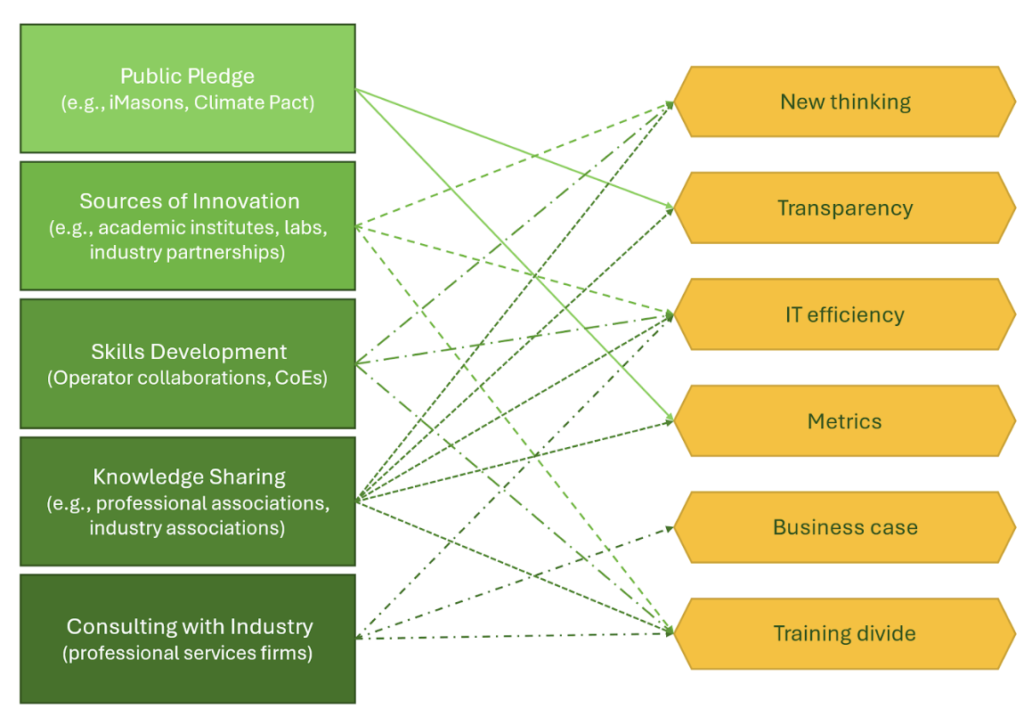
Figure. Organizations addressing industry issues
Sources of Optimism Going Forward
Digitization and the consequent explosion of data center growth are drawing attention to the data center industry, and efforts to green operations are helping to position the industry as a major actor in a new economy. Today, well-funded data center operators are invited to the table along with local governments and other sectors to discuss significant energy opportunities. Over the past several years, large technology providers have vied for top spot as the largest purchaser of renewable energy resources.30 Going forward, the hyperscalers and large providers are expected to accelerate innovation in the energy space, working solo and with energy companies to explore the potential for additional resources, such as geothermal, hydrogen, microreactors or grid nuclear, to deliver clean, reliable power, economically, safely, and at scale. At the same time, the industry can look forward to continued innovation at the facilities systems and IT levels. Software tools, if viewed in a supporting role, rather than as a threat to resiliency, have the potential to reduce energy consumption in the data center by a quarter to a third over a year or two.
These two factors – the potential to integrate additional clean power, and opportunities to reduce energy consumption via software optimization – introduce a note of optimism into the growth vs. sustainability conundrum. But to realize this potential, players across the data center ecosystem must continue to commit to green targets despite political winds, innovate to achieve these goals, report in a transparent way to motivate ongoing improvement, and cooperate by sharing their success stories. Greener Data is honored to play a role in that collaboration.
REFERENCES
1. As of June 2024, 107 countries, 1000 cities, 9,000 companies, 1,000 educational institutions, and over 600 financial institutions had pledged action to halve global emissions by 2030.
For a livable climate: Net-zero commitments must be backed by credible action. United Nations Climate Action. https://www.un.org/en/climatechange/net-zero-coalition
2. Jo Lindsay Walton. What is ICT’s global carbon footprint? Medium, March 2, 2024. https://medium.com/@jolindsaywalton/what-is-icts-global-carbon-footprint-1da8874ddc49
3. IPCC researchers have assumed that a 1% increase in GDP growth is associated with a .5% increase in CO2e emissions.
GeSI and Accenture. #SMARTer2030. ICT Solutions for 21st Century Challenges, pp. 9, 10. https://www.gesi.org/wp-content/uploads/2024/10/SMARTer2030-ICT-solutions-for-21st-Century-Challenges.pdf
4. Vida Rozite. Data centres & Data transmission Networks. IEA. July 11, 2023. https://www.iea.org/energy-system/buildings/data-centres-and-data-transmission-networks
5. James O’Donnell and Casey Crownhart. “We did the math on AI’s energy footprint. Here’s the story you haven’t heard.” Power Hungry: AI and our energy future. MIT Review. May 20, 2025.
6. Rozite.
Commenting on changes in US data center energy consumption 2010 to 2018 in light of efficiency improvements, researchers Eric Masanet, Arman Shehabi, Nuoa Lei, Sarah Smith and Jonathan Koomey noted, “Expressed as energy use per compute instance, the energy intensity of global data centers has decreased by 20% annually since 2010, a notable improvement compared with recent annual efficiency gains in other major demand sectors.
Recalibrating global data center energy-use estimates. Science Magazine. v. 367, issue 6481. February 2020. https://datacenters.lbl.gov/sites/default/files/Masanet_et_al_Science_2020.full_.pdf
7. The UN estimates decreases in global greenhouse gas emissions projected for 2030 (compared to 2019) currently sit at – 2.6% when – 43% is required to keep temperature increases below 2 degrees C.
UN. For a livable climate.
8. Putting America First In International Environmental Agreements. White House Presidential Action. January 20, 2025. https://www.whitehouse.gov/presidential-actions/2025/01/putting-america-first-in-international-environmental-agreements/
9. U.S. Securities and Exchange Commission. SEC Votes to End Defense of Climate Disclosure Rules. 2025. https://www.sec.gov/newsroom/press-releases/2025-58
10. CSA updates market on approach to climate-related and diversity-related disclosure projects. Canadian Securities Administrators, April 23, 2025. https://www.securities-administrators.ca/news/csa-updates-market-on-approach-to-climate-related-and-diversity-related-disclosure-projects/
11. Mark Segal. EU Parliament Agrees to Delay Sustainability Reporting and Due Diligence Laws. ESG Today. April 3, 2025.
12. Jillian Ambrose. Will global climate action be a casualty of Trump’s tariffs? The Guardian. April 11, 2025.
https://www.theguardian.com/environment/2025/apr/11/global-climate-action-casualty-trump-tariffs
13. Independent Energy Authority. Energy and AI. World Energy Outlook Special Report. April 2025. https://iea.blob.core.windows.net/assets/34eac603-ecf1-464f-b813-2ecceb8f81c2/EnergyandAI.pdf
14. Charlotte Freitag, Mike Berners-Lee, Kelly Widdicks, Bran Knowles, Gordon S. Blair, and Adrian Friday. The real climate and transformative impact of ICT: A critique of estimates, trends, and regulations. Patterns. Vol. 2, Issue 9. September 10, 2021.
15. Reflecting market volatility, AI adoption estimates range from to 40% to 80% of businesses in 2025.
FinSMEs. How Many Companies Are Using AI? April 9, 2025. https://www.finsmes.com/2025/04/how-many-companies-are-using-ai.html
Anthony Cardillo. How Many Companies Use AI? (New Data). Exploding Topics. March 4, 2025. https://explodingtopics.com/blog/companies-using-ai
16. Zachary Skidmore. xAI doubles number of onsite gas turbines at Memphis data center in violation of permit limits. Datacenter Dynamics. April 2025.
17. Arman Shehabi et al. 2024 United States Data Center Energy Usage Report. Energy Analysis and Environmental Impacts Division, Lawrence Berkeley National Laboratory. December 2024. https://eta-publications.lbl.gov/sites/default/files/2024-12/lbnl-2024-united-states-data-center-energy-usage-report.pdf?utm_source=substack&utm_medium=email
A recent EU report shared similar results as two thirds of data center survey respondents, who were able to report water usage, claimed an average WUE of 0.31 litres per kWh in 2023. EUDCA. State of European Data Centers 2025. May 2025. E8VdyUuATTC_BmbNp4nhAwo89
18. The public health impacts of data centers are an increasing focus of research, as pollutants from onsite generation and operations are now more closely linked to cancer risk. A data center in a particular region may be low carbon (powered by clean grid energy), but it may pose increased health risk depending on factors such as population density, wind direction and speed, or the height of smokestacks.
Yuelin Han, Zhifeng Wu, Pengfei Li, Adam Wierman, Shaolei Ren. The Unpaid Toll: Quantifying the Public Health Impact of AI. Cornell University. Computers and Science. December 2024.
https://doi.org/10.48550/arXiv.2412.06288
19. Shadow pricing, for example, is used to approximate value in the absence of established markets. Economic Value of Water. IWRM Action Hub. https://iwrmactionhub.org/learn/iwrm-tools/economic-value-of-water
20. Key organizations in North America offering data center training include the DCD Academy, IDCA, Uptime Institute/CNet Training.
21. Berkeley Center for New Media. Certificate in Global Digital Infrastructure – Digital Infrastructures. Launching Summer 2025.
22. Five hundred survey respondents from across Canada were responsible for ICT procurement, ICT operations management, or ICT product and service development.
A. Clark and M. Mathews. ICTC Policy Brief: Advancing Environmentally Sustainable ICT in Canada. Information and Communications Technology Council (ICTC), p. 22. 2023. advancing-environmentally-sustainable-ict-in-canada.pdf
23. Infrastructure Masons. State of the Digital Infrastructure Industry 2024 Report, p. 21. https://imasons.org/wp-content/uploads/2023/04/iMasons_State-of-the-Digital-Infrastructure-Industry_2024-Annual-Report.pdf
24. The iMasons Climate Accord. Open Letter on EPD Adoption. July 16, 2024. https://climateaccord.org/news/open-letter-on-epd-adoption/
25. As the pact allows use of offsets to achieve carbon neutrality, this commitment may be better characterized as market-based, rather than true carbon neutrality.
26. The Climate Neutral Data Centre Pact Announces its First Certifications of Adherence. July 6, 2023. https://www.climateneutraldatacentre.net/2023/07/06/the-climate-neutral-data-centre-pact-announces-its-first-certifications-of-adherence/
27. The Green Grid’s Data Center Resource Effectiveness (DCRE) Standing Work Group. WP#93 Data Center Resource Effectiveness (DCRE) Metric. February 17, 2025. https://www.thegreengrid.org/resources/library-and-tools/wp93-data-center-resource-effectiveness-dcre-metric
28. European Commission. Energy Efficiency Directive. https://energy.ec.europa.eu/topics/energy-efficiency/energy-efficiency-targets-directive-and-rules/energy-efficiency-directive_en
29. A. Clark and M. Matthews. ICTC Policy Brief: How to Advance Environmentally Sustainable ICT in Canada. Information and Communications Technology Council (ICTC), 2023. https://ictc-ctic.ca/policy-briefs/advancing-environmentally-sustainable-ict-in-canada
K. Carr, A. Clark, and M. Matthews, Building a Sustainable ICT Ecosystem: Strategies and Best Practices for Reducing Environmental Harms in a Digital World. Information and Communications Technology Council (ICTC), 2024. https://ictc-ctic.ca/reports/building-a-sustainable-ict-ecosystem30. Paul Gerke. Are renewable energy credits enough? Big tech companies take contrasting approaches to cleaning up their act. Factor This. January 6, 2025. https://www.google.com/search?q=tech+companies+compete+to+be+biggest+purchasers+of+renewable+energy&rlz=1C1CHBF_enCA1048CA1049&oq=tech+companies+compete+to+be+biggest+purchasers+of+renewable+energy&gs_lcrp=EgZjaHJvbWUyCAgAEEUYChg5MgcIARAhGI8C0gEJMTU0MjhqMGo0qAIIsAIB8QUoiqy-T9e6bw&sourceid=chrome&ie=UTF-8

Author: Courtney Burrows
Courtney Burrows is the Executive Editor of Greener Data and Executive Vice President of Marketing and Sustainability at JSA, where she leads content strategy across PR, marketing, and media initiatives for the global digital infrastructure industry. With more than 20 years of experience — and over a decade dedicated to data centers — she curates expert insights focused on data center sustainability, innovation, and the evolving demands of an AI-driven world.