


By Jim Summers, GPC Infrastructure
This chapter is an excerpt from Greener Data: Volume Three, launched on Earth Day 2026. Featuring perspectives from 75+ sustainability leaders across the digital infrastructure ecosystem, the full book is available now on Amazon.
I was never much of an athlete in high school. While this fact no doubt impacted my social life, recognizing it led me down a path that would change my life forever. For what I lacked in athletic prowess, I made up for in curiosity. And that curiosity, combined with a penchant for arguing with my classmates, led me to competitive debate. I finally found my “passion,” and through it I began to learn about the world around me.
In my senior year, the debate topic was “Resolved: The United States Federal Government should employ all U.S. citizens living in poverty.” My partner and I had the clever idea of putting those citizens to work building solar panels and wind farms while phasing out gas and coal for good measure. Thus began my lifelong fascination with energy. After a year of researching the virtues of renewable energy and the evils of fossil fuels, I became a true believer.
This conviction stayed with me through college, and when it came time to look for a job, I decided to ignore the recruiters in oil and gas, which were so prevalent at the University of Oklahoma in 1990. All of them, except for one, that is.
Conoco was hiring for its “Management Development Program” and had built a reputation as the most difficult interview on campus. This was too big a challenge to pass up, so I took the call. A week later, I had a plane ticket to Houston (an actual paper ticket!). While I had no intention of going to the “dark side”, I figured it would be good practice for the tech company interviews I had coming up, so I reluctantly agreed.
I’m not sure if it was the culture, the people, or the sheer magnitude of the challenge, but after my trip to Houston, I was in. There was only one thing holding me back. Conoco was a fossil fuel company. Weren’t they evil? I turned to my dad for advice. He told me I had a choice: I could watch from the sidelines, or I could change the world from the inside. His logic swayed me, and I began my journey with Big Oil. First at Conoco, and then 11 years later with BP.
The deregulation of gas and power in the late 1990’s afforded me the opportunity to step into a broad range of technical and commercial leadership roles. It was an exciting time for the industry and natural gas was the belle of the ball.
Over a ten-year span, the U.S. built about half of the combined cycle natural gas power plants in operation today. I had the opportunity to be a part of many of them. What I found most interesting, first at Conoco and then later at BP, was the proliferation of natural gas-fired on-site power projects being developed at large industrial sites and the compelling economic returns they provided.
Toward the end of the power boom, I got my wish and took a role developing wind, solar, and other renewable energy projects. My dream of changing things from the inside finally came true. And while I enjoyed my time working in renewable energy, I learned that not everything is as one sided as it sometimes seems. All forms of energy have pros and cons.
Fast-forwarding 20 years, I find myself once again in the middle of a power boom. Other authors in this book will likely expand upon the unprecedented growth of data centers and the insatiable appetite for power that has followed. For my part, I can say that in my 35 years in energy, this feels bigger than anything I’ve seen before.
As the uniquely different worlds of energy and high-power compute collide, the focus has been on solving the immediate problems of speed to market and reliability for new data centers. A lack of generation and, perhaps more importantly, transmission capacity at the utility level has pushed online dates for new data centers years into the future. Timing and cost uncertainty have driven many data center operators to take matters into their own hands and move to on-site solutions (often referred to as “behind the meter”) as an alternative to the grid.
The need for dispatchable, reliable, and flexible power has pointed to natural gas as the near-term solution. The challenge, however, is Big Tech’s narrative of a carbon-free future, which has embraced renewables as the hero and cast fossil fuels as the villain.
Over the past year, the story has evolved. I regularly hear “Sustainability must take a back seat so we can win the AI race” and “Gas is just a bridge” (to what is not always clear) rather than a permanent solution. I believe both of these statements to be false.
The thesis of this chapter is that on-site natural gas generation is not only a long-term solution but perhaps the most important decision we can make to ensure the sustainability of our environment going forward.
I’ll make 3 major points to support this belief:
•On-Site Gas is More Efficient Than the Grid
•On-Site Gas is More Sustainable Than the Grid
•Moving Away from Sole Reliance on the Grid is the Key to Decarbonization
On-Site Gas is More Efficient Than the Grid
On-site or “behind the meter” power generation is not new. Before utilities came into being, it was the only option for generating electricity. Even with the advent of localized utility networks, large industrial customers with high energy demands, such as chemical plants, refineries, and pulp and paper mills, realized that the most efficient, reliable, and cost-effective way to generate electricity was to do it themselves.
By combining on-site generation with waste heat recovery, Combined Heat and Power (CHP) facilities can be significantly more efficient than a new combined cycle power plant. At both Conoco and BP, we favored CHP projects over other merchant generation opportunities for their economic and sustainability benefits.
Today, there are over 4,600 on-site CHP installations totaling 80 gigawatts and representing 7% of U.S. electric generation capacity; 72% of these are fueled by natural gas.
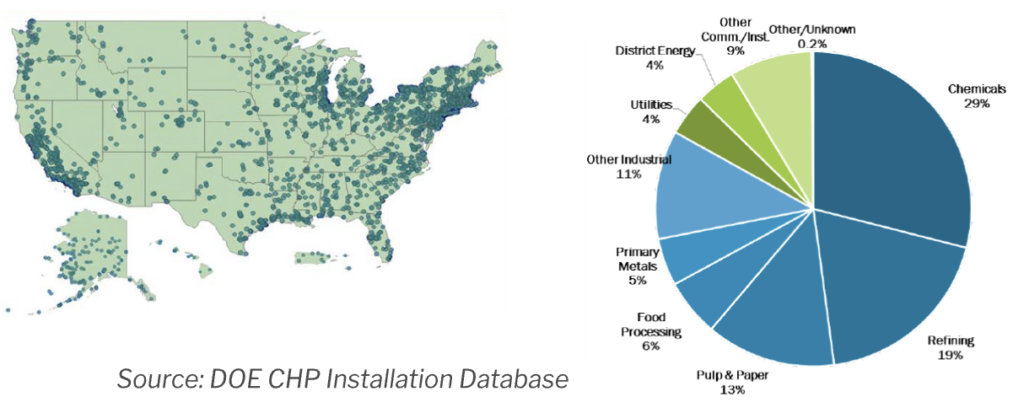
Source: DOE CHP Installation Database
Modern data centers and “AI factories” with energy demand ranging from a few megawatts to well over a gigawatt can dwarf the power consumption of these large industrial users.
On average, about 70% of a data center’s electricity demand is used for powering processing chips, while the remaining 30% is used for cooling. This creates a unique opportunity, making data centers ideal candidates for CHP applications.
By utilizing waste heat from on-site generation to run absorption chillers and/or steam turbines, a data center can meet nearly a third of its energy demand without using any additional fuel or creating any incremental emissions. This ultra-efficient energy approach can be tailored to meet the customer’s specific needs at the exact location where they need it.
By contrast, the “grid,” which is a collection of over 3,000 separate utilities scattered across the country, is by definition all things to all people. By balancing the needs of residential, commercial and industrial customers with a multitude of energy generation resources such as wind, solar, gas, coal, and even nuclear, utilities are performing a perpetual supply and demand juggling act.
In addition, transmission and distribution losses for an electric utility can range from 5 – 15% depending on the location. This means the grid must generate even more energy (and the associated emissions) to deliver power to where it’s needed.
Compared to the grid, on site generation is not only a quicker path to energization but wildly more efficient. This also means it is much cleaner.
The environmental impact of inefficiency is evident in the EPA’s Emissions and Generation Integrated Database (eGrid). According to the data shown in the table below, the average CO2 emissions rate across the country is 823 lbs/megawatt-hour (MWh), with some regions emitting much more. Coal fired power plants can emit up to 2,300 lbs/MWh.
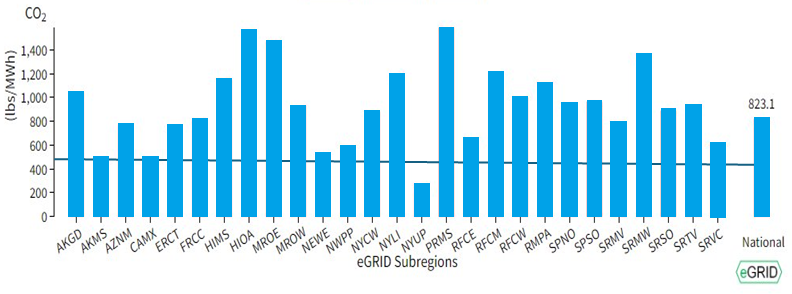
By comparison, on site generation using natural gas-powered turbines and engines, when combined with waste heat capture, can reach efficiencies above 80% with resulting emissions below 500 lbs/MWh.
This is cleaner than all but one of the 27 utility subregions and is nearly 40% better than the grid average.
On-Site Gas is More Sustainable Than the Grid
According to the U.S. Energy Information Administration (EIA) and the Office of Energy Efficiency & Renewable Energy, from 2006 to 2020, the U.S. added 127 GW of wind and 96 GW of solar generation capacity. A staggering increase, given that in 2005 they represented less than 1% of total electric generation. Collectively, wind and solar today comprise over 10% of the electricity we produce1. And while renewables deserve the praise they get for being a clean source of energy, the unsung hero in the story of carbon reduction has been natural gas. EIA data shows that since 2006 roughly 1.5 trillion tons of CO2 have been reduced by switching from coal to gas.
This is nearly twice the emissions reductions from new renewables.
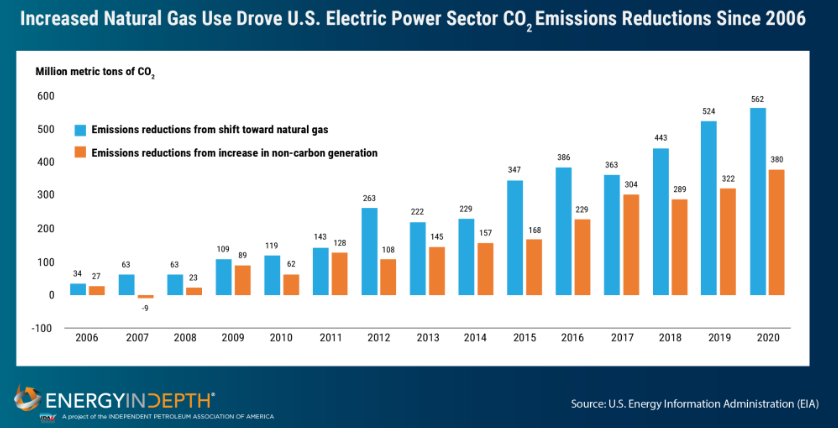
As a result, greenhouse gas emissions have steadily declined, with current levels 21% below their 2005 peak, as shown in the table on the next page.
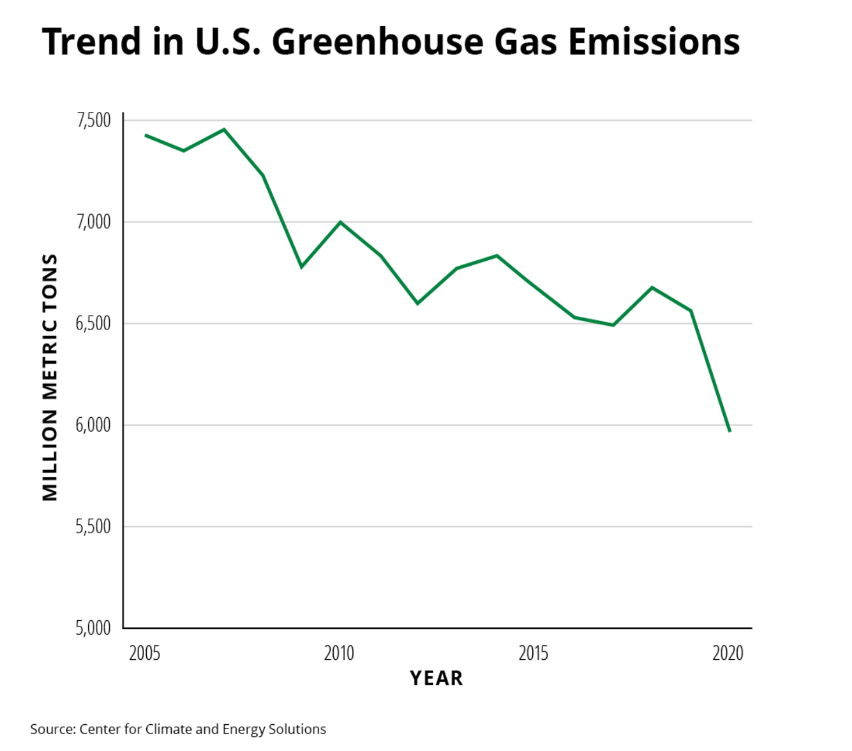
However, current projections indicate this trend is reversing. Intermittent resources such as wind and solar cannot meet data centers’ baseload power demands and are approaching saturation in some markets. New utility-scale combined-cycle gas and nuclear plants promise a long-term solution but face supply chain constraints and regulatory hurdles.
In the near term, utilities’ go-to option has been delaying coal plant retirements. In 2024, 4.0 GW of coal was retired compared to an average of 9.8 GW over the prior 10 years2. Projections from the Global Carbon Project show greenhouse gas emissions in 2025 increasing by 1.9%3. As new data centers lean on the grid to meet increased demand, it’s hard to see this trend changing in the near term.
Another challenge faced by grid operators is the growing need for new high-voltage transmission. 70% of our current transmission infrastructure is over 25 years old4. A 2024 Department of Energy report highlights the need to build 5,000 miles per year of high-capacity transmission for the next ten years to support reliability, projected growth, and clean energy goals. From 2020 to 2023, we’ve averaged just 350 miles per year.5 While the environmental impact of this new transmission is difficult to quantify, it will certainly be profound across the country.
The CEO of American Electric Power, one of the largest investor-owned utilities in the U.S. and operator of the nation’s largest transmission system commented recently: “It took over 100 years of planning and building to create our current system, and a step-change in infrastructure investment on an accelerated timeline will be required to serve even a fraction of this future demand in a reliable manner”.6
By contrast, the U.S. has modernized its gas pipeline network. Driven by the shale revolution and the advent of horizontal drilling and hydraulic fracking, we currently produce 25% of the world’s natural gas and have constructed over 10,000 miles of pipeline in the past 5 years. An additional 50,000 miles is planned, underpinned by a robust forward market for natural gas.7
By leveraging available gas resources and existing pipeline infrastructure, on-site generation does not require new transmission, thereby avoiding both grid energy losses and the environmental impact of new power lines.
By bringing their own generation, data centers can play a significant role in helping utilities manage their future demand and invest in the resources necessary to most economically achieve their reliability and sustainability goals.
Moving Away from Sole Reliance on the Grid is the Key to Decarbonization
The energy we consume today comes from a mix of many generation types. Because wind and solar are available only about 20 – 40% of the time, most of the energy produced comes from other sources such as natural gas (43%), nuclear (18%), or coal (16%).8
Given a data center’s need for 24/7 baseload power and up to 99.999% reliability, even the most altruistic company can use only a small fraction of renewables to meet their overall energy needs.
While some data center operators are investing directly in on-site renewable energy projects, the vast majority are buying power directly from the utility and “offsetting” the resulting emissions by purchasing Renewable Energy Credits (RECs). REC’s are generated by renewable project developers separately from the underlying energy and traded in commodity markets or sold directly to the consumer via “virtual” power purchase agreements.
While these REC sales have no doubt contributed to the growth of the renewable energy sector, many believe they are producing little to no emissions reductions going forward.9
A recent report from the Greenhouse Gas Management Institute notes that the voluntary markets for RECs do not influence investments in renewable energy generation capacity, nor do they induce greater energy output from existing renewable generation capacity.
By contrast, on-site gas generation provides the option to purchase flared or Renewable Natural Gas (RNG) from landfills or dairy-based biodigesters that would otherwise have been released into the atmosphere, creating a net reduction in greenhouse gas emissions when used for power generation. By blending a portion of this waste gas (typically less than 15%), the data center can achieve a true net-zero carbon impact.
In some locations, capital investments can be further future proofed by installing new carbon capture facilities or retrofitting existing equipment to run on hydrogen.
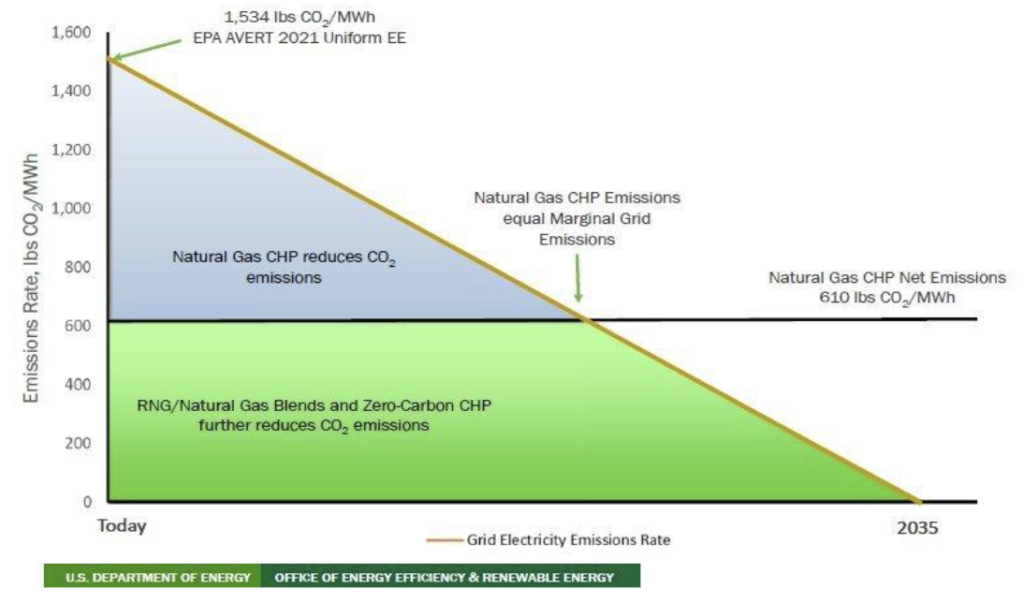
The graphic below from the Department of Energy highlights that the efficient use of natural gas through on-site generation and waste heat recovery can take us a long way toward a carbon-neutral future. Once those opportunities have been fully realized, blending RNG and zero-carbon fuels such as “Green” Hydrogen can take us the rest of the way.
Defining the Next Century of Infrastructure
Throughout my career, I have witnessed tremendous growth in the infrastructure necessary to generate, transport, and deliver energy to the world around us. I’ve lived through the deregulation of natural gas and power, the explosion of wind and solar, billions going into liquified natural gas import terminals, only to have billions more spent to turn them into export terminals. I experienced firsthand the profound geopolitical impacts of dependence on foreign oil and the effect of horizontal drilling in reversing that dependence.
Today, we are witnessing in real time perhaps the biggest transition of them all. The exponential growth of data centers supercharged by AI is clearly changing the way we see the world. The impact on how we view energy is no less transformational.
Just like the personal “crisis of faith” in clean energy I faced when I left college, the maturing technology industry is at a crossroads.
Understanding the underlying impacts of relying on the grid to meet these challenges is critical to informing the choices we make today. Embracing on-site natural gas as an alternative that leverages lessons from the past and the technology of the present can have a profound impact on the sustainability of our planet well into the future.
RESOURCES
1. U.S. Energy Information Administration. (2025, February). Electric power monthly with data for December 2024. https://www.eia.gov/electricity/monthly/
2. U.S. Energy Information Administration. February 25, 2025. Planned retirements of U.S. coal-fired electric-generating capacity to increase in 2025. https://www.eia.gov/todayinenergy/detail.php?id=64604
3. Global Carbon Project. Global Carbon Budget 2025. https://globalcarbonbudget.org/carbonbudget2025/
4. U.S. Department of Energy. January 19, 2022. Building a Better Grid Initiative to upgrade and expand the nation’s electric transmission grid to support resilience, reliability, and decarbonization. Federal Register. https://www.federalregister.gov/d/2022-00883
5. U.S. Department of Energy. October 2024. National Transmission Planning Study. Grid Deployment Office. https://www.energy.gov/gdo/national-transmission-planning-study
6. Fowke, B. May 21, 2024. Statement of Ben Fowke, Interim Chief Executive Officer and President, American Electric Power: Hearing to examine the opportunities and challenges associated with expansion of electric transmission [Testimony]. U.S. Senate Committee on Energy and Natural Resources. https://www.energy.senate.gov/services/files/7F2AC3C4-87CB-4562-99F8-5BB999FC6433
7. The INGAA Foundation. 2018. North American midstream infrastructure through 2035: Capital investments and procurement requirements. Prepared by Black & Veatch. https://www.ingaa.org/ingaa-foundation-reports/
8. Ember. March 2025. US electricity 2025: Special report. https://ember-energy.org/latest-insights/us-electricity-2025-special-report/
9. Gillenwater, M. 2008. Redefining RECs (Part 1): Untangling attributes and offsets. Energy Policy, 36(6), 2109–2119. https://doi.org/10.1016/j.enpol.2008.02.036

Author: Courtney Burrows
Courtney Burrows is the Executive Editor of Greener Data and Executive Vice President of Marketing and Sustainability at JSA, where she leads content strategy across PR, marketing, and media initiatives for the global digital infrastructure industry. With more than 20 years of experience — and over a decade dedicated to data centers — she curates expert insights focused on data center sustainability, innovation, and the evolving demands of an AI-driven world.