


By Jack Backes, Provident Data Centers
This chapter is an excerpt from Greener Data: Volume Three, launched on Earth Day 2026. Featuring perspectives from 75+ sustainability leaders across the digital infrastructure ecosystem, the full book is available now on Amazon.
Back in February 2021, Storm Uri ripped through my home state of Texas and took out the grid, causing an unprecedented energy blackout as temperatures plummeted and ice storms wreaked havoc. At the time I was living in California. Deep in Covid lockdowns, I was unable to contact my mother for eight days. I found out later that she was trapped in her home, huddled in blankets or keeping warm in her car. She was fortunate, the winter storm caused the deaths of 246 people, mostly due to extreme cold exposure or hypothermia.
There were many factors that contributed to the power failure, all to do with the Texas energy system, the only standalone grid in the US. At a huge cost – personal and economic – we discovered how vulnerable we were to a surge in demand and a decrease in supply as natural gas systems froze.
Storm Uri helped shape my view that the country needs a more consistent and predictable baseload for grid stability, a minimum level of electricity demand that is available 24/7. It became clear to me that nuclear energy is the most viable way forward.
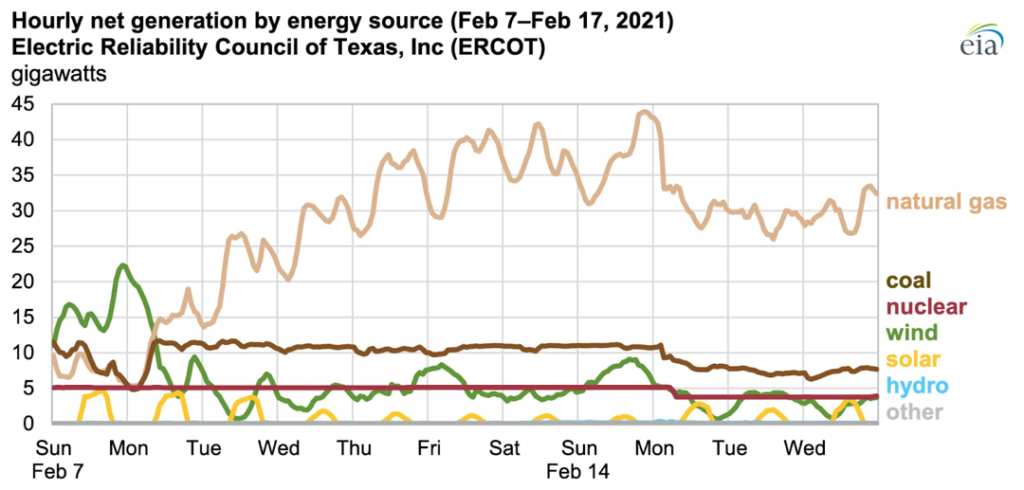
This chart shows power generation by source during winter storm Uri. When you examine hourly net generation during the storm by energy sources, nuclear is among the lowest contributors yet it’s also the most reliable. It is represented by a straight line that runs across the graph, while natural gas, coal, and renewables fluctuate, particularly wildly in the case of gas 1.
Anyone looking at this from the data center industry will recognize the possibilities for an “always-on” foundational layer of power – just what the sector needs as demand for AI and high-density computing grows.
Proven and Reliable Source of Energy
Making the transition to nuclear should not be a huge step, because it’s a here-and-now energy source with 94 commercial reactors operating in nuclear plants across 28 states. Constellation Energy is the largest operator, with 25 reactors and a track record that shows how nuclear is becoming increasingly efficient. Capacity factor (the percentage of maximum possible output a plant actually delivers) rose from around 60% industry-wide in the 1980s to 94.5% in 2021.In the summer of 2025, Constellation’s fleet hit 98.8%.
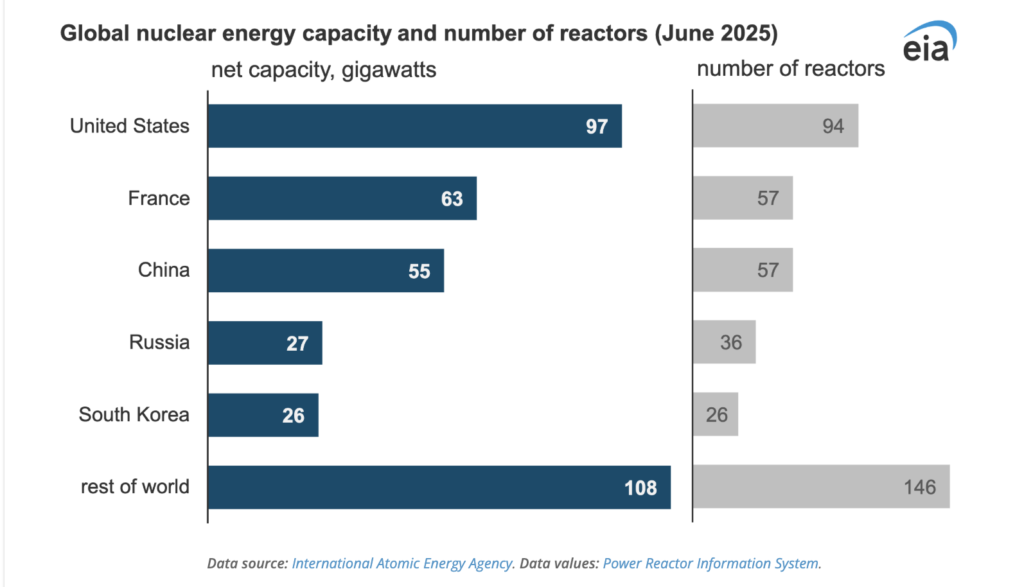
Around the world, nuclear energy is an established power source, with countries like France and South Korea generating 67% and 30% of their country’s total energy respectively. In decades of operation, neither has experienced a major accident, and both have built reputations for standardized reactor designs. They are considered leaders in the field.
In the US, we have the most nuclear reactors (see diagram) but they only account for 18% of total electrical output in the country. We are at an inflection point, where we have an opportunity to build on this and join France and South Korea as a global force in nuclear energy. Nuclear power stations, specifically SMRs (small modular reactors), are fast emerging as the go-to-fix for data centers. Hyperscalers Amazon, Google, and Microsoft are actively investing in the next generation of reactors to meet surging demand, and plan for them to go live around 2030.
Real-world developments show a resurgence of interest in nuclear energy, whether it’s US start-ups like Applied Atomics, working with light-water reactor (LWR) technology, or established names like Westinghouse, developing a 330MWe SMR. If high-growth is sustained, nuclear capacity could more than double by 2050, rising from current levels of around 377 GW to nearly 992 GW. SMRs are expected to contribute about 24% of the new capacity2.
There is momentum here that our sector should unanimously embrace.
Accelerating the Nuclear Rollout
Even in the US Government, a discernible shift in policy is loosening rules that previously restricted the nuclear industry. After decades of shutdowns, plant decommissioning, underinvestment and too much red tape (safety orders are still beyond any other industry in the country), there are positive signs that the tide is turning.
New legislation allows federal agencies to enter into longer-term Power Purchase Agreements (PPAs) of up to 40 years with nuclear utilities, where previously these were capped at 10 years – too short to justify the high upfront capital costs of building new reactors. By enabling the government to act as an anchor customer for new reactors, the law de-risks private investment and sends a strong market signal that new nuclear energy has a future. Another positive move saw the Nuclear Regulatory Commission cut its review period for construction permit applications from 36 months to 18, with X-energy’s Xe-100 reactor in Texas among the first to benefit.
All of this is good news for the nuclear industry and for Texas, where an advanced role for nuclear energy could be key to avoiding the kind of outages experienced during Storm Uri. The Texas Nuclear Alliance’s (TNA) governing board sees a real opportunity to lead the nation in AI and energy reliability, a vision shared by Provident. We are the first data center developer to join the TNA and support its commitment to making nuclear a more viable option in the state.
Further help has come from the Texas House of Representatives, which passed a bill to establish funding mechanisms and regulatory support to accelerate nuclear energy deployment.
Green Credentials and Energy Density
The data center community should welcome these developments, because nuclear energy provides what the sector badly needs. Massive new investments are focused on nuclear, rather than solely on solar or wind, because nuclear power’s unique green and sustainable benefits align perfectly with the growing need for continuous and dense power.
Nuclear reactors do not burn carbon-based fuels; they emit virtually no CO₂, NOₓ, SO₂ or other air pollutants during operation. Their total environmental impact, the carbon footprint per kilowatt-hour – from mining, construction, and operation to decommissioning and waste management – is significantly lower than coal or natural gas, and comparable to wind and solar.
Nuclear power also offers unparalleled energy density with 1kg of uranium-235 equivalent to burning three million kilograms of coal. Land-use efficiency is another win, with a typical 1,000 MW nuclear facility occupying far less land than equivalent solar or wind farms.
The biggest advantage, however, is the continuous baseload electricity that nuclear energy provides, regardless of weather or daylight. Such 24/7 reliability helps stabilize the grid, reduces reliance on fossil-fuel backup generation, and addresses the very specific requirements of AI.
Continuous and Resilient Supply
Modern data centers need continuous, resilient energy at scale, which is a challenge when grids are straining under the weight of intermittency. As the world continues to be digitally transformed, putting pressure on data centers to do more, countries are running out of grid capacity, sticking with outdated national energy policies, creating connection queues that are delaying the development of new facilities and becoming a barrier to innovation.
There has been a lot of work on the policy front in the last year, but further delays come at the worst possible time. Large AI training compute clusters rival small cities at needing 300MW to over a GW of power – compared to 5–10 MW in a traditional data center use. The International Energy Agency projects that global data center electricity consumption will more than double by 2030, driven largely by these workloads, and the build-out of new generation and transmission capacity struggles to keep pace.
Renewables can play a pivotal role in meeting this demand by offering a sustainable alternative to fossil fuel generation and CO₂ emissions. But they are often intermittent where AI data center demand is constant. And they are often distributed, whereas data centers need concentrated power delivered to a single site.
Even when a region has abundant renewable capacity, real-time availability does not match the continuous load that is needed. Grid-scale batteries can handle daily fluctuations, but they can’t solve multi-day or seasonal variability on their own. This can cause costs to grow quadratically when days or weeks of backup are required. Natural gas “peaker plant” infrastructure can help fill gaps in demand but also comes at a high cost.
Navigating the Remaining Obstacles
A few obstacles still need to be navigated, however, not least the time frame. Data centers need more power now, but the new breed of nuclear reactors are not expected to be ready until 2030 at the earliest. Natural gas generators can fill the gap. They are portable and scalable, allowing data centers to bridge the period before SMRs are widely available. The flexibility and ubiquity of natural gas can play an essential role, but it is not a long-term solution, however tempting the value proposition might seem. The storms in Texas are a reminder of its limitations.
Another obstacle is the way nuclear energy is purchased. Right now, data centers cannot buy a reactor, they can only buy a PPA, a procurement process that will have to be revisited if we want the sector to keep up with demand. Perhaps there is a role for an independent power producer to step in and free up the market, providing mechanisms that allow the sector to stop buying engines and start chartering jets.
Of course, there is another obstacle, the lingering misconceptions around nuclear power. There is a legacy belief that nuclear plants are inherently dangerous, that waste is difficult to manage, or that it is more expensive than renewable alternatives. But modern waste management methods mean it is easily contained. Today’s reactors use fuel that is “safe by design,” and modularity quickly reduces the “first of a kind” cost seen with bespoke custom reactors.
Conclusion
A nuclear flywheel is beginning to spin, where investment and technological improvement lead to lower costs, more adoption, and operational experience that drives continual improvement. Choosing SMRs for data center power is not a leap of faith, it is an embrace of progress already unfolding, a way of creating and managing a large baseload energy source that is better for the stability of the grid. Crucially, SMRs come at a time when data centers are becoming even more power hungry with the advent of AI and high-density computing.
Nuclear energy can’t undo the tragedy of Storm Uri, but we can use the lessons to help prevent the next one. The policy window is open, investment is flowing, and decades of safe, reliable operation have laid the foundation for a new generation of reactors. What’s needed now is a pragmatic focus on enabling deployment at scale. The data center industry can lead the way and, in doing so, also serve our customers’ demand for reliable power.
1. U.S. Energy Information Administration, Hourly Electric Grid Monitor (ERCOT demand, net generation, and interchange)
2. International Atomic Energy Agency, Energy, Electricity and Nuclear Power Estimates for the Period up to 2050.

Author: Courtney Burrows
Courtney Burrows is the Executive Editor of Greener Data and Executive Vice President of Marketing and Sustainability at JSA, where she leads content strategy across PR, marketing, and media initiatives for the global digital infrastructure industry. With more than 20 years of experience — and over a decade dedicated to data centers — she curates expert insights focused on data center sustainability, innovation, and the evolving demands of an AI-driven world.