


By Samuel Rabinowitz, LANTANA LED
This chapter is an excerpt from Greener Data: Volume Three, launched on Earth Day 2026. Featuring perspectives from 75+ sustainability leaders across the digital infrastructure ecosystem, the full book is available now on Amazon.
As the data center industry heeds the call to rein in carbon emissions and energy usage, the spotlight has been cast everywhere but up – literally to the lights illuminating the buildings. Although lighting makes up 17% of all electricity consumed in U.S. commercial buildings1, it’s a largely overlooked aspect of building design. In data centers specifically, lighting accounts for a relatively small percentage of overall power consumption (typically in the neighborhood of 3-5%); however, it represents the most accessible and immediate opportunity for energy reduction. Unlike complex changes to power and cooling infrastructure, upgrading to advanced LED solutions and power sources offers immediate ROI.
In a large-scale AI facility or across several data centers encompassing hundreds of megawatts of capacity, the impact of efficient lighting can be significant, not only for overall energy consumption, but also for facility safety, security, temperature stabilization, maintenance, and productivity.
In this case study, we highlight how LANTANA LED partnered with industry experts to deliver a lighting solution for a 60MW high-density AI data center and, in the process, demonstrated how lighting technology can contribute meaningfully to the efficiency and maintainability of large-scale data centers.
The Challenge: Lighting for the AI Era
As the industry grapples with curbing energy use, LED lighting is preferred for its energy efficiency, longer lifespan, enhanced safety, and other benefits, including temperature stabilization and lower maintenance costs.
In data centers specifically, lighting is often dismissed as a minor line item. However, this oversight ignores the “double penalty” of inefficient illumination: lights not only consume electricity but generate heat that must be removed by cooling systems.
In a large-scale AI facility, the impact of efficient lighting extends beyond the meter. It is a critical component of thermal management, facility safety, and the precise visual environment required for maintaining complex high-density racks.
Even more than traditional enterprise data centers, AI data centers are characterized by intense compute densities, elevated heat loads, and stringent uptime requirements. With AI servers drawing power and generating heat far beyond conventional racks, environmental conditions are pushed to their limits, particularly in the hot aisles where temperatures can exceed 100°F.
Lighting design for such spaces must satisfy a unique set of requirements:
•Thermal resilience: Fixtures must perform reliably under sustained high ambient temperatures.
•Minimal maintenance demands: Given the density and cost of AI equipment, any work performed above servers carries significant risk. Additionally, the current dearth of skilled data center technicians calls for lighting solutions that require minimal maintenance.
•Energy efficiency: Lighting contributes to the overall energy profile of a data center, and reducing even small percentages of energy use can translate into substantial savings at scale.
•Safety and visibility: Maintenance and service work require precise illumination that does not interfere with thermal containment or airflow management.
Project Scope and Team Collaboration
The installation took place in a 60MW AI data center, covering approximately 67,000 square feet of high-density compute space. The client is a global data center developer specializing in modern, high-performance facilities designed to support hyperscale, HPC, and AI workloads. They focus on building scalable campuses with accelerated deployment timelines to meet the rapidly growing demand for advanced digital infrastructure across multiple regions.
The design team sought a lighting solution that balanced performance, durability, and efficiency, while meeting the tight construction timeline typical of large-scale hyperscale projects. With ongoing labor shortages across the data center industry, finding lighting solutions that cut down on installation time and ongoing maintenance were key considerations.
To achieve these goals, LANTANA LED collaborated closely with:
•SK & Associates, which provided design guidance and technical consultation on fixture selection and control integration.
•Critical Facility Group, a full-service engineering design, construction observations, and data center operations support.
•Chewning & Wilmer, the electrical contractor responsible for executing the installation to meet both engineering and aesthetic standards.
Solution: Remote Drivers and High-Temperature Fixtures
At the heart of the solution was the LANTANA high-temperature Edge LED Linear fixture that is engineered to deliver consistent performance in environments where ambient temperatures often exceed 100°F. The operator installed 700 new lights, paired with advanced distributed low-voltage technology enabled by a Remote Driver Unit (RDU).
Traditional LED fixtures rely on integrated drivers located at or near the light source. In high-heat applications, however, this design can compromise reliability and shorten lifespan. By separating the driver from the fixture, LANTANA’s remote driver system allows sensitive electrical components to be installed outside the thermal envelope for safety and longevity.
Key Benefits of the Remote Driver Design and Distributed Low Voltage Power:
1. Improved Reliability:
By moving drivers away from the high-temperature zone, component degradation is significantly reduced. This approach minimizes premature failures, a common issue in hot aisle lighting.
2. Energy Efficiency:
Operating at lower voltages, these systems consume less power and have a longer lifespan, leading to significant energy savings over time and contributing to greener data center facilities.
LED drivers are among the most temperature-sensitive elements in a fixture. By isolating them from heat, overall system efficiency is improved, and fixture lifespan is extended by as much as 25–40% compared to integrated-driver designs.
3. Increased Capacity:
Reduced kW on lighting and cooling gives capacity back to the owner.
4. Flexibility and Scalability:
These systems offer exceptional flexibility, allowing data center operators to easily expand or reconfigure their lighting setup as needed.
5. Safety:
Lower voltage translates to reduced risk of electrical shock during installation and maintenance.
6. Cost and Labor Savings:
As the industry continues to find greater efficiency in the face of a shortage of skilled labor, distributed low-voltage systems provide overall cost and labor savings. Electrical contractors can install faster, leveraging the prefabrication benefits of low voltage, by turning over key components faster or delivering the same excellence with smaller crew sizes. For less cost and a faster turnover, owners are able to capitalize on the intrinsic benefits of low-voltage lighting.
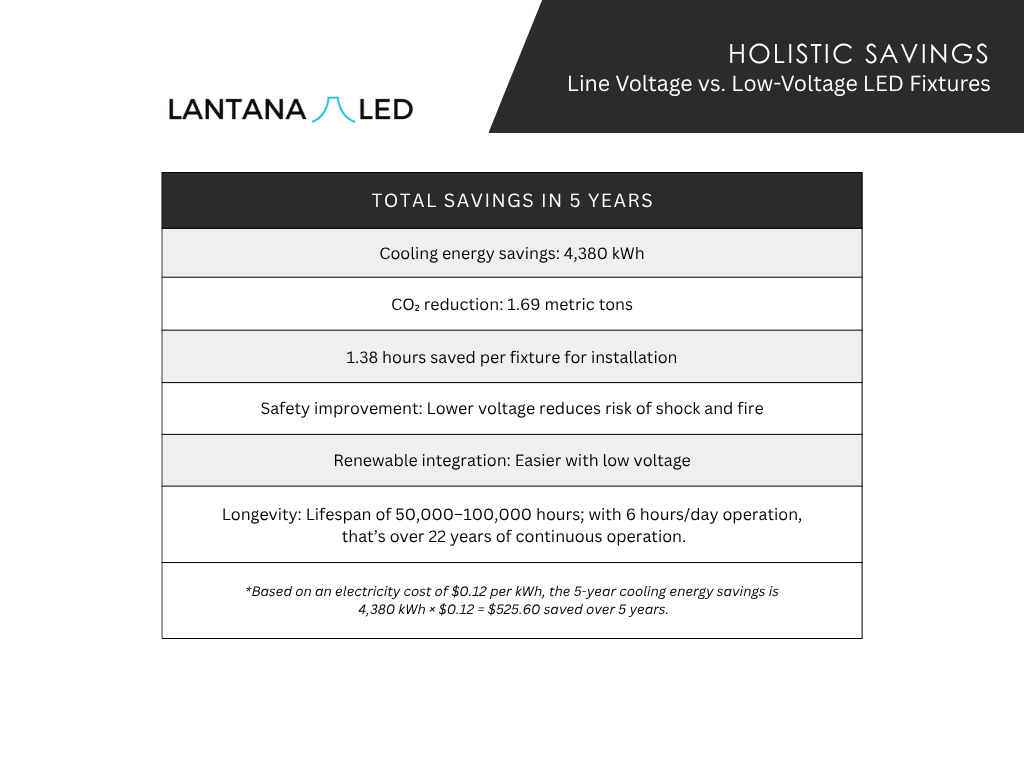
According to an independent study by Inglett & Stubbs, a premier electrical contractor experienced in digital infrastructure, installing low-voltage LED lighting vs. line voltage lighting in a 40,000-square-foot hyperscale data center saved approximately 1.38 installation hours per fixture, resulting in a total labor time savings of 375 hours2.
7. Optimized Control and Monitoring:
Remote drivers also enable more sophisticated lighting control strategies, allowing integration with DCIM and smart facility systems for dimming, occupancy sensing, and centralized monitoring, further driving energy savings.
Results: Energy Efficiency and Sustainability Impact
When comparing 700 LED line voltage fixtures and 700 LED low voltage fixtures over a five-year period, both systems offer similar efficacy and long lifespans, but low voltage LED fixtures like those adopted by the client in this case study provide distinct environmental and sustainability benefits.
Heat Generation and Cooling Load
Fixture Heat Output
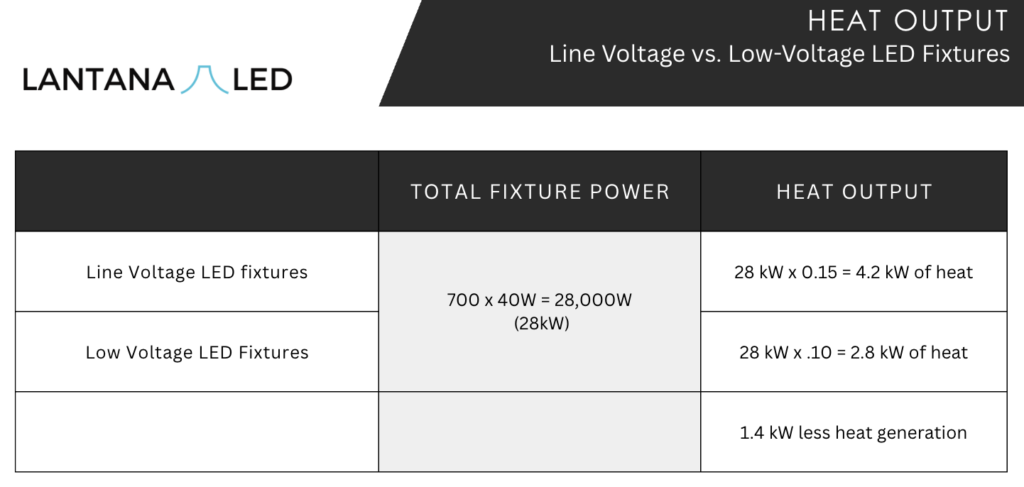
Line voltage LED fixtures, which typically operate at 120V or 240V, carry higher power-conversion losses, with roughly 15% of their energy use dissipating as heat. In a facility running 700 fixtures at 40 watts each, that amounts to 28 kW of lighting power and approximately 4.2 kW of heat added to the mechanical cooling load.
By contrast, low-voltage LED fixtures convert power more efficiently, with only about 10% of their energy turning into heat. For the same 28 kW of lighting power, low-voltage options contribute just 2.8 kW of heat. When translated into cooling requirements, the difference becomes even more meaningful. Assuming a cooling system with a Coefficient of Performance (COP) of 3.5, removing the heat produced by line voltage fixtures requires approximately 1.2 kW of cooling energy, while low-voltage fixtures require only 0.8 kW.
Over time, this gap compounds.
With lighting operating an average of six hours per day, line voltage fixtures consume about 2,628 kWh of cooling energy annually, compared to 1,752 kWh for low-voltage lighting. Across a five-year horizon, the cumulative difference amounts to 4,380 kWh in avoided cooling energy.
Cooling Energy Required
To understand the downstream impact of lighting efficiency, it’s important to consider how much cooling energy is required to remove the heat that lighting fixtures generate.
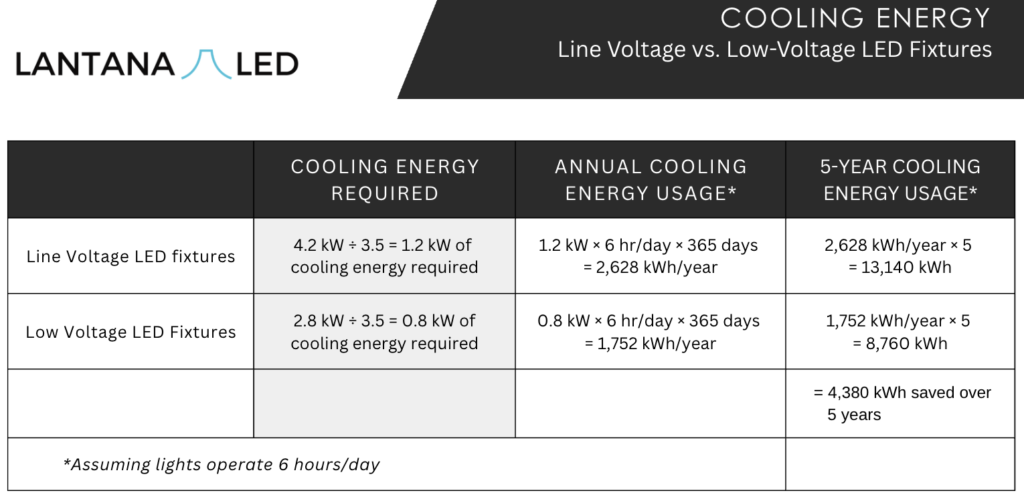
Most modern data center cooling systems operate with a Coefficient of Performance (COP) of 3.5, meaning they can remove 3.5 kW of heat for every 1 kW of energy consumed. Under this metric, the 4.2 kW of heat produced by line-voltage LED fixtures demands roughly 1.2 kW of cooling energy, while the lower 2.8 kW heat load from low-voltage fixtures requires only about 0.8 kW. The accompanying chart highlights how these differences accumulate across the full system.
Energy and Carbon Emissions Savings
Although both lighting systems consume the same amount of energy for illumination (28,000 W [28 Kw]), the reduced cooling demand of the low-voltage system creates a measurable efficiency advantage. Over five years, this difference translates into 4,380 kWh of avoided energy use. Using the average U.S. grid emissions factor of 0.85 lbs CO₂ per kWh means the prevention of approximately 3,723 pounds (1.69 metric tons) of CO₂ from entering the atmosphere.
The chart below assumes:
•Both systems consume the same energy for lighting: 700 × 40W = 28,000 W (28 kW)
•Lighting energy use: 28 kW × 6 hours/day × 365 days = 61,320 kWh/year
•Over 5 years: 306,600 kWh for lighting (same for both systems)
Safety and Renewable Compatibility
In addition to meeting its core objectives, the deployment of LANTANA LED’s low-voltage system provided several unexpected operational advantages.
Centralized power and control enabled safer, more efficient maintenance, while the simplified architecture reduced both system complexity and operational risk. Because the fixtures operate at safer low voltages (typically 12V or 24V), they further minimize electrical hazards during installation and service. Their compatibility with low-voltage DC power also allows seamless integration with solar arrays and battery backup systems, strengthening resilience and supporting long-term sustainability goals.
The Sustainability Context: Lighting’s Role in Green Data Centers
According to the U.S. Department of Energy, data centers account for 1–1.5% of total global electricity consumption, a figure that continues to rise with the growth of AI workloads. The industry’s response has been a multi-faceted push toward sustainability that includes renewable energy sourcing, liquid cooling, waste heat recovery, and intelligent power management.
Lighting, while often a smaller piece of the puzzle, remains a critical part of the holistic sustainability strategy. Efficient lighting contributes not just to reduced energy bills, but also to improved human comfort and operational safety, which are factors that enable longer equipment life and higher uptime.
By combining high-temperature durability, remote driver architecture, and intelligent controls, LANTANA LED delivered a system that not only meets the performance demands of an AI data center but also contributes to its broader mission: to operate more efficiently, more safely, and more sustainably.
As we say at LANTANA LED, “Every watt matters,” and we believe our approach represents a model for what’s possible when innovation meets purpose.
RESOURCES
1. “Upgrade Your Lighting.” ENERGY STAR. https://www.energystar.gov/buildings/save-energy-commercial-buildings/ways-save/upgrade-lighting
2. “Installation Analysis of Line Voltage vs Low Voltage LED Lighting.” LANTANA LED. https://info.lantanaled.com/hubfs/2023%20LANTANA%20LED%20Whitepapers/Cost%20Analysis%20(5).pdf?utm_content=262314892&utm_medium=social&utm_source=facebook&hss_channel=fbp-101006115476338

Author: Courtney Burrows
Courtney Burrows is the Executive Editor of Greener Data and Executive Vice President of Marketing and Sustainability at JSA, where she leads content strategy across PR, marketing, and media initiatives for the global digital infrastructure industry. With more than 20 years of experience — and over a decade dedicated to data centers — she curates expert insights focused on data center sustainability, innovation, and the evolving demands of an AI-driven world.