


By Pierre-Adrien Bel & Louis Liu, Rehlko
Environmental Product Declaration (EPD) is a standardized, third-party verified document that reports a product’s environmental impacts throughout its entire life cycle. It summarizes the result of an in-depth Life Cycle Assessment (LCA) for a building material, system, or piece of equipment – conducted in accordance with the ISO 14040/14044 standards.
Despite being considered the industry gold standard to measure and disclose a product’s lifecycle footprints, the complexity and resources needed to develop an EPD, especially for Mechanical, Electrical, and Plumbing (MEP) equipment, remain key barriers limiting the speed and scale of adoption.
In this chapter, we will review the growing industry and regulatory demands of EPD and decode how it plays a critical role to drive Scope 3 Greenhouse Gas (GHG) emissions accounting transparency and supply chain decarbonization. In addition, present a case study examining how Rehlko developed its market-first EPD for mission-critical generators – and leveraged the LCA result to drive sustainable product innovation. By sharing our lessons learned and business case, we hope to encourage more MEP equipment suppliers to join us in unlocking the benefits of EPD development and turning this disclosure obligation into a competitive edge.
What is EPD and How Is It Created?
Similar to a nutrition label that details the amount of calories and nutrients contained within our food, an EPD provides detailed material composition of a product and its lifecycle environmental impacts. The process of creating an EPD begins with defining the product and its functional unit, followed by conducting a comprehensive LCA to quantify impacts such as GHG emissions, energy consumption, and resource use across a product’s life cycle stages.
For a backup generator, for example, the functional unit is defined as the ability to produce 1 kVA of electrical energy to ensure an emergency power supply when the main grid fails. For this type of product, the LCA mainly covers raw material extraction, manufacturing key components such as the engine and alternator, assembly into a complete generator set, maintenance and operational readiness throughout its service life, and finally end-of-life treatment.
The system boundaries typically include cradle-to-grave stages, from material sourcing to disposal, ensuring a complete view of environmental performance. These results are compiled into a clear and structured report, which is verified by a third-party program operator like UL, PEP ecopassport® to ensure its compliance with the internationally recognized standards such as ISO 14025 and EN 15804. This process provides credibility and transparency to the environmental claims made by the manufacturers.
Benefits of EPD and Industry Demand
Because of its standardized framework and stringent process of value chain data gathering and verification, EPD has emerged as the authoritative framework for measuring and disclosing a product’s lifecycle environmental impacts. As a result, EPD is being leveraged as a multifaceted tool to meet various industry needs. This includes accounting for data center operators’ Scope 3 (value chain) GHG emissions, enabling suppliers’ embodied carbon measurement and reduction, supporting property owners’ green building certifications, fulfilling manufacturers’ regulatory compliance, and accelerating decarbonization efforts across the data center supply chain and other built environment sectors.
Scope 3 Accounting
GHG Protocol defines Scope 3 emissions as an organization’s indirect emissions upstream and downstream of its value chain. For a data center owner and operator, Scope 3 emissions often account for over 90 percent of its total GHG emissions. However, the complexity and lack of visibility into an organization’s many tiers of supply chain make it challenging to account for the environmental footprint associated with its purchased goods and services.
Traditional spend-based estimation methods produce results lacking precision and product-specific insights to drive meaningful reduction strategies. EPDs, by contrast, provide standardized, third-party verified lifecycle impact data at the individual product level — enabling data center operators to calculate Scope 3 emissions with the same rigor applied to Scope 1 and 2 emissions accounting, and offering product lifecycle insights to explore Scope 3 reduction opportunities.
Industry Demand
The iMasons Climate Accord (iCA) published an open letter in 2024 calling for all suppliers in the digital infrastructure industry to adopt EPDs to support the measurement and reduction of embodied carbon emissions in data centers. Signed by members of iCA’s governing body – including AWS, Digital Realty, Google, Meta, Microsoft, and Schneider Electric – the letter represents a coalition with a combined market capitalization of over $8 trillion, underscoring the tremendous buying power they wield across the digital infrastructure supply chain. This letter sent a strong market signal asking suppliers to adopt EPDs to measure and disclose their products’ environmental footprints.
The demand signal from hyperscale data center operators has moved well beyond informal preference — it is now showing up directly in procurement. Multiple hyperscale operators have incorporated EPD availability as a formal criterion in RFQ and RFI documentation for data center infrastructure equipment. For suppliers, this means EPD is no longer a nice-to-have differentiator; it is increasingly a threshold requirement for consideration in major procurement cycles.
Building sector pledges including AIA 2030, MEP 2040, and SE 2050 are embedding EPD requests into RFPs, spec sections, and whole-building LCAs — creating consistent demand signals across the supply chain, including for mission-critical equipment. Green building certification, such as the U.S. Green Building Council (USGBC)’s LEED certification, accredits building owners for selecting materials and equipment with EPD available.
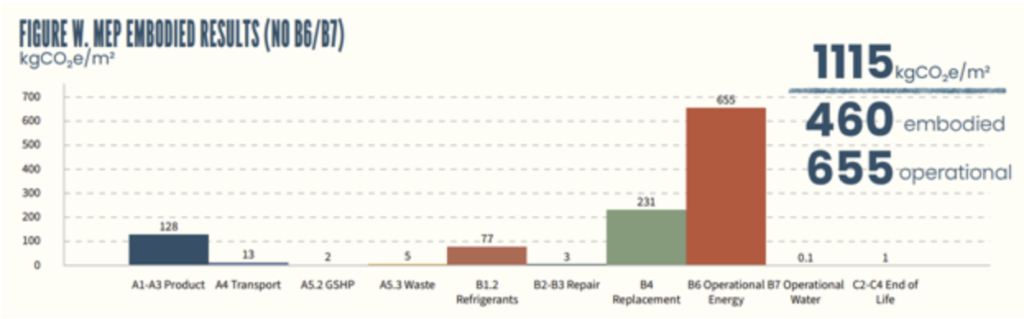
Figure 1. Whole life carbon framework for MEP systems, showing EPD-informed life cycle assessment stages from cradle to grave that provides great insights into a building’s embodied and operational carbon. Source: MEP 2040 (2025)
Beyond voluntary market commitments, regulatory frameworks are beginning to mandate environmental transparency for industrial products.
Regulatory Compliance
The European Union’s Digital Product Passport (DPP), introduced under the Ecodesign for Sustainable Products Regulation (ESPR), requires manufacturers to provide machine-readable, standardized environmental and circularity data for a growing range of product categories. Energy-related products — including power generation equipment — are among the priority categories identified for early implementation, with phased requirements entering force from 2026 onward. For equipment manufacturers like Rehlko with European operations and customers, DPP compliance will require documented lifecycle data that closely mirrors what is already captured in an EPD. Organizations that have already invested in LCA and EPD development are therefore significantly better positioned to meet DPP obligations as regulations mature. They can avoid the cost and disruption of building compliance infrastructure from scratch under regulatory deadline pressure.
The Challenges of Creating EPDs
Despite the clear industry demand, EPD development for MEP equipment remains uncommon. Unlike commodity materials such as concrete or steel where EPD adoption is now widespread, mission-critical equipment manufacturers face a steeper path: gathering verified lifecycle data across dozen of suppliers on complex components, navigating the absence of product-specific Product Category Rules (PCR), managing the cost and resource to support third-party verification, and committing to a development process that can span 12 to 24 months. Rehlko faced each of these barriers when it set out to develop what would become the market’s first EPD for a mission-critical generator — and the process revealed as much about opportunity as it did about challenge.
Case Study: Rehlko’s Market-First EPD for Mission Critical Generators
Development Process, Partners, and Standards
Published in May 2024, Rehlko’s first EPD for a mission-critical generator from 2,000 kVA to 4,500 kVA was developed to provide transparent, standardized environmental data and comply with international sustainability frameworks. We adopted the PEP ecopassport® program, applying PCR-ed4-EN (2021-09-06) as the Product Category Rules. Since no product-specific rules exist for backup generators, the general PCR guidelines for Electrical, Electronic, and HVAC-R Products were used to ensure consistency and credibility.
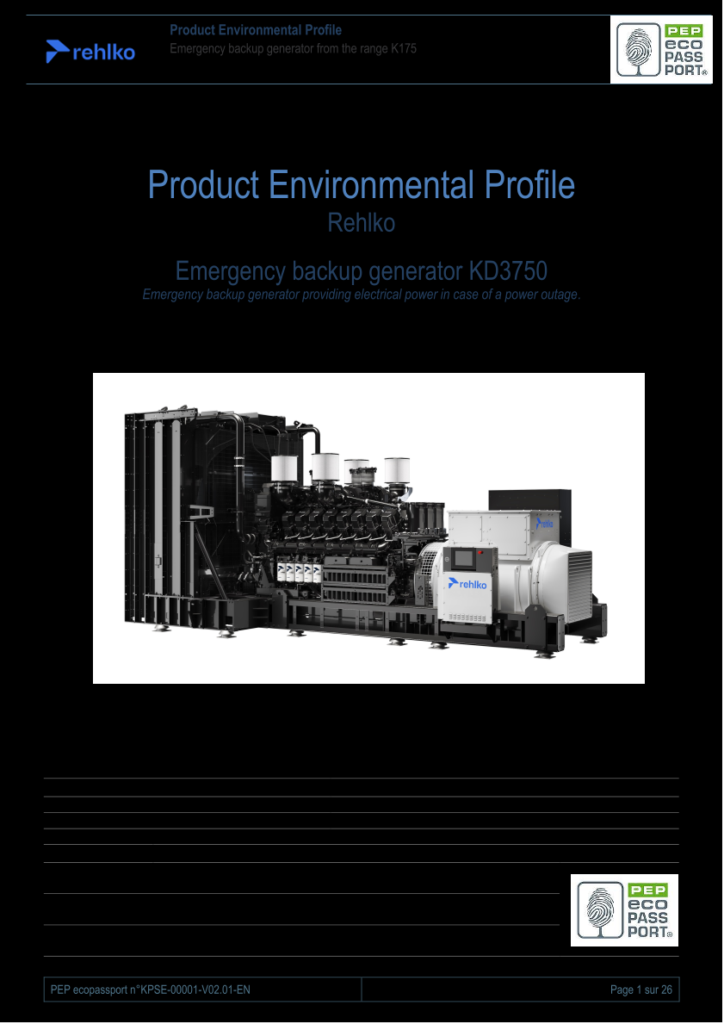
Figure 2. Rehlko’s (formerly Kohler Energy) Market-First EPD for Mission-Critical Generators
The functional unit was defined as producing 1 kVA of electrical energy to secure a power supply during a main grid failure. We conducted a comprehensive Life Cycle Inventory (LCI), covering all stages: raw material extraction, manufacturing of key components (engine, alternator, frame), assembly at our French plant, maintenance (including oil, coolant, and part replacement), and end-of-life treatment. Collaboration with suppliers was essential for accurate data collection, and an independent verifier ensured compliance with ISO 14025 and EN 15804 standards.
While operational fuel consumption falls outside the EPD system boundary — as it depends on conditions beyond the manufacturer’s control — the fuel use of generator testing and maintenance are captured in the full LCA and informs the product’s sustainability roadmap.
Result of the EPD
The EPD analysis quantified the material composition of the generator and identified the main environmental hotspots. Steel, cast iron, copper, and aluminum made up over 94 percent of the total product mass. The upstream phase (A1–A3) accounted for most impacts, driven by steel, aluminum, and copper used in the engine and alternator. Copper was a particularly significant contributor due to its high embodied energy and the carbon intensity of its primary production.
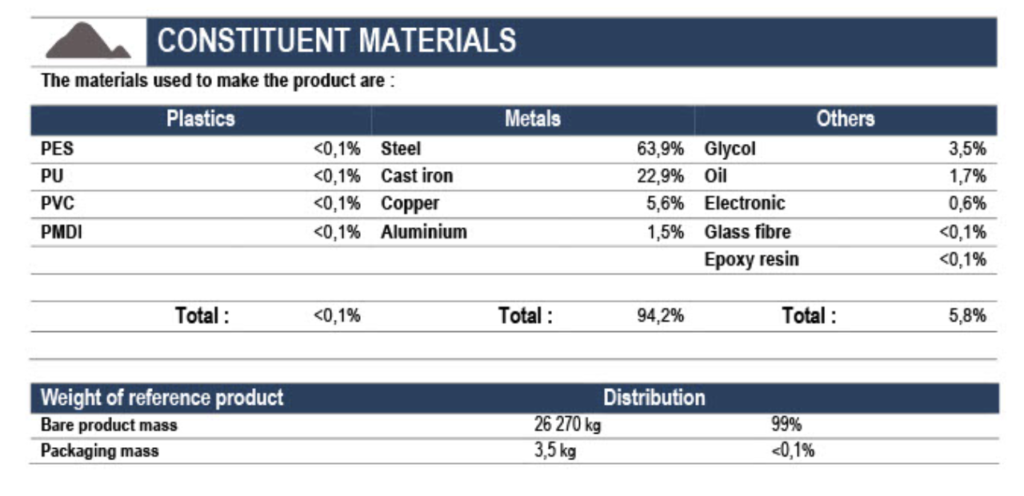
Figure 3. Material composition of the Rehlko KD3750-F mission-critical generator by mass, as documented in the PEP ecopassport® lifecycle assessment. Metals — including steel (63.9%), cast iron (22.9%), copper (5.6%), and aluminum (1.5%) — account for 94.2% of total product mass. Source: Rehlko (2024)
In the use phase, the engine heater, oil and coolant changes, and fuel consumption were key contributors to lifecycle impact. While diesel fuel carries a substantial carbon footprint, switching to Hydrotreated Vegetable Oil (HVO) can significantly reduce these use-phase emissions.
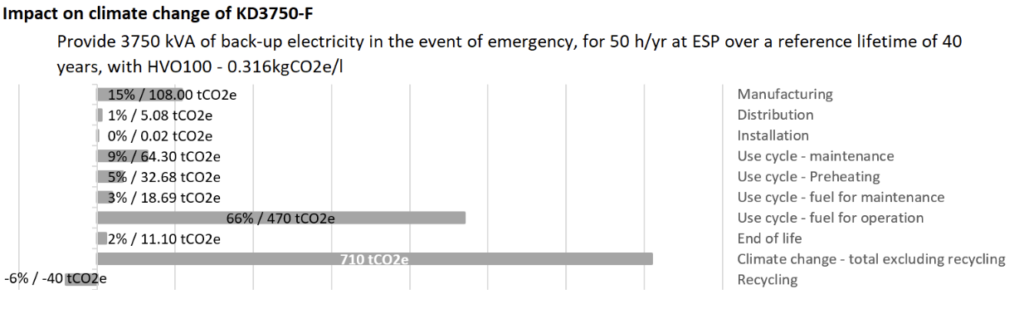
Figure 4. Lifecycle impact of a mission-critical generator (Rehlko’s KD3750), assuming operational runtime of 50 hours a year for a product lifetime of 40 years using HVO fuel.
Actions Taken – Driving Low-Carbon Innovation
The EPD results guided our New Product Development (NPD) strategy by highlighting environmental hotspots. We have since then taken a number of actions to develop low-carbon solutions to reduce those hot spots, including:
•Material optimization: Investigating low-carbon steel, aluminum alternatives and reducing copper usage where feasible.
•Design improvements: Weight reduction and enhanced recyclability.
•Fuel strategy: Promoting HVO as a sustainable alternative to diesel.
•Maintenance optimization: Extending oil and coolant change intervals and introducing low-carbon coolant.
•Heat recovery: Leveraging IT waste heat to maintain engine temperature, reducing standby energy consumption.
•Supplier engagement: Requesting verified LCA/EPD data for critical components.
A key success was our collaboration with Leroy Somer (Nidec). At the time of our LCA, they were not ready to publish an EPD, but our engagement prompted them to commit to developing and publishing their own EPD for alternators. This partnership demonstrates how industry collaboration accelerates sustainability through a supply chain ripple effect.
Future plans include expanding EPD coverage across additional product lines from 800kVA to 1800kVA and sustaining leadership in driving low-carbon mission-critical power generation solutions.
By leveraging EPD results, Rehlko is driving low-carbon, mission-critical power solutions and setting a benchmark for product transparency and decarbonization in the industry. Leveraging the EPD assists data center and digital infrastructure decision makers with bringing lifecycle thinking into product and sourcing conversations, showcasing the value that hybrid energy systems can create to help decarbonize data centers and make them more sustainable.
Lessons Learned and Actionable Steps towards EPD Adoption and Supply Chain Decarbonization
Scaling EPD adoption and moving the needle from measurement to decarbonization requires collective effort across operators, suppliers, and the broader ecosystem. Below are actionable steps for each audience:
Equipment Manufacturers / Suppliers
•Initiate first EPD development for your products most frequently purchased in the digital infrastructure industry
•Develop and certify EPDs across a product family range where applicable.
•Select EPD Program Operator and Product Category Rule that are most applicable to your product
•During the New Product Development process, request supplier data on material composition and sourcing location. Use an LCA inventory template or TM65 manufacturer form to standardize data collection
•Use LCA/EPD results to analyze hotspots in product’s lifecycle and identify key opportunities of emissions reduction
•Leverage EPD insights to propose low-carbon solutions in the New Product Development roadmap to drive continuous product innovation
Data Center Owners / Operators
•Request EPD in RFP and supplier equipment specifications
•Include the product environmental data disclosure requirement in the Supplier Code of Conduct
•Work with manufacturers to identify lifecycle footprint hot spots and discuss design alternatives to reduce those hotspots and drive product innovation
•If no EPD is available for a specific supplier, benchmark comparable EPDs from equivalent equipment categories
•Incentivize dematerialization – reduce size and weight where possible while maintaining the functional unit
•Discuss end-of-life disposal of pathways with manufacturers at the point of procurement
•Benchmark EPD across multiple suppliers to establish internal carbon intensity baseline per product category
Design & Construction Ecosystem
•Specify EPD requirements in design documents, RFPs, and basis-of-design selections to create consistent upstream demand
•Conduct whole-building LCAs using product-level EPDs to connect equipment choices to project-wide embodied carbon targets
•Engage manufacturers early in design to explore lower-carbon alternatives before procurement decisions are locked in
Closing Thoughts
EPD development is not a compliance exercise — it is a strategic investment in product transparency, market access, and supply chain leadership. Rehlko’s experience demonstrates that the barriers are real but surmountable, and that the returns extend well beyond the document itself: better products, stronger supplier relationships, and a credible position at the table as the industry accelerates toward decarbonization. We hope this account encourages more MEP equipment manufacturers to take that first step.
RESOURCES
American Institute of Architects. (n.d.). The AIA 2030 Commitment. AIA. https://www.aia.org/design-excellence/climate-action/zero-carbon/2030-commitment
European Commission. (2024, July 19). Sustainable products to be norm for consumers with new regulation. European Commission Environment. https://environment.ec.europa.eu/news/sustainable-products-be-norm-consumers-new-regulation-2024-07-19_en
European Committee for Standardization. (2022). EN 15804:2012+A2:2019/AC:2021: Sustainability of construction works — Environmental product declarations — Core rules for the product category of construction products. CEN. https://www.en-standard.eu/bs-en-15804-2012-a2-2019-sustainability-of-construction-works-environmental-product-declarations-core-rules-for-the-product-category-of-construction-products/
Greenhouse Gas Protocol. (2011). Corporate value chain (Scope 3) accounting and reporting standard. World Resources Institute & World Business Council for Sustainable Development. https://ghgprotocol.org/corporate-value-chain-scope-3-standard
Houde, K., Jensen, A., & Shinn, K. (2025). Beginner’s guide to MEP embodied carbon. MEP 2040 & Carbon Leadership Forum. https://www.mep2040.org/guide
iMasons Climate Accord. (2024, January 26). Environmental product declarations & lifecycle assessment [Case study]. https://climateaccord.org/case-studies/accounting-for-carbon-in-data-center-equipment/
iMasons Climate Accord. (2024, July 16). AWS, Digital Realty, Google, Meta, Microsoft and Schneider Electric call for supplier action to help decarbonize digital infrastructure [Press release]. https://climateaccord.org/press-releases/call-for-supplier-action-to-help-decarbonize-digital-infrastructure/
iMasons Climate Accord. (2024, July 16). Open letter on EPD adoption. https://climateaccord.org/news/open-letter-on-epd-adoption/
International Organization for Standardization. (2006). ISO 14025:2006: Environmental labels and declarations — Type III environmental declarations — Principles and procedures. ISO. https://www.iso.org/standard/38131.html
International Organization for Standardization. (2006). ISO 14040:2006: Environmental management — Life cycle assessment — Principles and framework. ISO. https://www.iso.org/standard/37456.html
International Organization for Standardization. (2006). ISO 14044:2006: Environmental management — Life cycle assessment — Requirements and guidelines. ISO. https://www.iso.org/standard/38498.html
Kohler Power System EMEA. (2024, May). Product environmental profile: Mission-critical standby generator KD3750-F (PEP ecopassport No. KPSE-00001-V01.00-EN). PEP ecopassport Programme. https://assets.ctfassets.net/y9fczihu867g/1pYnwKW93uNPgtuJqsARi5/77dd2864c3b3047a44c62b404160b348/KD3750_PEP_EN_Kohler.pdf
PEP ecopassport Association. (n.d.). PEP ecopassport programme. https://www.pep-ecopassport.org
Rehlko. (2024, June 25). Kohler Energy publishes a market-first environmental declaration for a mission-critical generating set [Press release]. Rehlko Power Systems. https://www.powersystems.rehlko.com/sea/kohler-energy-publishes-a-market-first-environmental-declaration-for-a-mission-critical-generating-set

Author: Courtney Burrows
Courtney Burrows is the Executive Editor of Greener Data and Executive Vice President of Marketing and Sustainability at JSA, where she leads content strategy across PR, marketing, and media initiatives for the global digital infrastructure industry. With more than 20 years of experience — and over a decade dedicated to data centers — she curates expert insights focused on data center sustainability, innovation, and the evolving demands of an AI-driven world.