


Muhammad Sarwar, 1Finity — a Fujitsu company
This chapter is an excerpt from Greener Data: Volume Three, launched on Earth Day 2026. Featuring perspectives from 75+ sustainability leaders across the digital infrastructure ecosystem, the full book is available now on Amazon.
Digital infrastructure has become the backbone of modern life, powering everything from cloud computing to artificial intelligence (AI)-driven applications. As AI workloads and data center networks scale exponentially, the pressure on data center interconnect (DCI) and optical transport networks has intensified at a pace the industry has never experienced before.
This growth brings not only startling bandwidth demand but also a sustainability challenge that threatens long-term viability. Across hyperscalers, cloud providers, telecom operators and enterprises, the question is no longer whether capacity can grow; it’s whether it can grow sustainably.
Sustainability concerns are driven by multiple converging forces: rising power consumption, increasing thermal density, space limitations, escalating operational costs and tightening environmental regulations. Traditional approaches to scaling optical transport infrastructure can no longer keep pace. Incremental efficiency improvements, while valuable, are insufficient to overcome the exponential growth in traffic.
To support the future of digital ecosystems, the industry must adopt a comprehensive transformation. This effort will focus on improving power per bit, optimizing thermal performance, leveraging integration and semiconductor advancements, and deploying liquid cooling as a mainstream technology.
Pressure Mounts as Networks Heat Up
Today’s data center operators face rising costs, unsustainable power needs, and space constraints. As AI-driven computing expands, DCI networks must transport massive volumes of data at ever-increasing speeds. Higher capacity systems are being deployed to meet demand, but these systems consume more absolute power even as power per bit improves. The result? Overall energy usage continues to climb, and thermal loads intensify.
This creates a vicious cycle: more power means more heat, which requires more cooling, driving up operational expenses and carbon footprint. Compounding the challenge, equipment is concentrated into smaller footprints due to space limitations, further increasing heat density and impacting reliability and lifecycle performance.
For operators, this is not just a technical issue, it’s a business imperative. Sustainability goals and Service Level Agreements (SLAs) are harder to meet, costs rise, and profitability suffers. Clearly, incremental improvements are not enough. A fundamental transformation is required.
Approaching Sustainability Holistically
Sustainability in DCI networks must be addressed across all layers of optical transmission – from transmission systems to line systems to network architecture and operations. The goal is simple: reduce power per bit while maximizing throughput and reliability. This involves leveraging a combination of advanced semiconductor technologies, innovative cooling solutions, and operational automation across all levels of the ecosystem.
•Component level: digital signal processors (DSPs), modulators, drivers, lasers, and pump technology.
•Module/system level: coherent pluggables, neutral host pluggable transponder, multi-rail line systems including reconfigurable optical add-drop multiplexers (ROADMs) and in line amplifiers (ILA).
•Architecture level: C+L-band architectures, direct attached ROADMs, telemetry-driven control.
•Network level: AI-driven optical link planning and design tools, automated diagnostics, and maintenance.
•Facility level: cooling architecture, power distribution, and energy reuse.
The primary objective across all layers is reducing watts per gigabit while minimizing material usage and extending equipment lifespan. Operators must adopt a holistic approach that considers not only hardware efficiency but also lifecycle impacts, supply chain sustainability, and integration with renewable energy sources. Metrics such as watts per gigabit and carbon emissions per terabit transported are becoming key performance indicators for next-generation networks.
Integration and CMOS Advancements as the Foundation of Power-Per-Bit Reduction
One of the most powerful levers for sustainability is higher integration enabled by complementary metal–oxide–semiconductor (CMOS) technology improvements. Modern coherent DSPs and optical components are increasingly integrated into single packages, reducing interconnect losses and improving efficiency. This miniaturization lowers power consumption per bit and reduces footprint, enabling more capacity in less space.
Next-generation CMOS technology is one of the most important enablers of sustainable optical transport. As coherent DSPs move from 7 nm to 5 nm to 3 nm, each new node provides major gains. Advanced CMOS nodes allow DSPs to operate at higher baud rates with lower voltage, cutting energy use significantly.
For example, transitioning to 3nm CMOS can reduce DSP power consumption by up to 30% while supporting baud rates exceeding 130 Gbaud. Combined with photonic integration, these advancements deliver a step-change in efficiency, critical for hyperscale environments where every watt matters. Higher transistor density enables more complex forward error correction (FEC), equalization, and shaping algorithms within the same power budget.
Higher baud rates translate into fewer required wavelengths for a given spectrum. For example, with 130Gbaud transceivers in 150GHz channels, the C Band can be filled up with only 32 channels. Fewer channels reduce the number of erbium-doped fiber amplifiers (EDFAs), ROADMs, and related systems, yielding enormous reductions in operational power. This amplification effect makes CMOS scaling a powerful sustainability tool.
The shift toward greater integration, including silicon photonics, indium phosphide, and hybrid materials, is another major sustainability contributor. Integrating modulators, drivers, TIAs, filters, and even lasers into tightly-coupled photonic circuits brings several efficiency gains:
•Reduced optical insertion loss means lower required laser power.
•Co-location of electrical and optical elements shortens interconnect paths, reducing parasitic capacitance and electrical drive requirements.
•Smaller module footprints reduce material consumption and embodied carbon.
•Improved thermal conduction paths, increasing component lifetime.
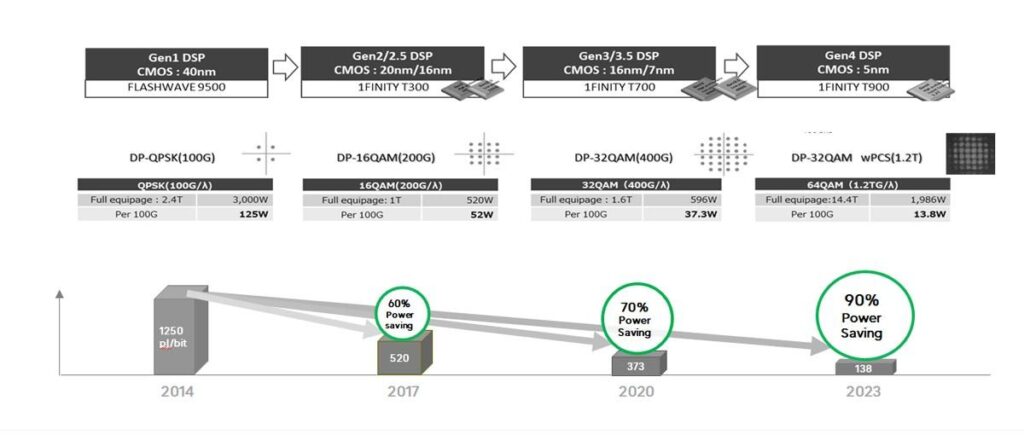
Evolution of coherent optical transmission
Miniaturization and Modular Design
Miniaturization doesn’t just save space; it reduces thermal load and simplifies cooling. Modular architectures allow operators to scale capacity as needed, optimizing both power and space utilization. For example, multi-rail dense wavelength-division multiplexing (DWDM) designs enable multiple independent fiber pairs to share common infrastructure, reducing duplication and improving sustainability.
By consolidating components into fewer chassis and leveraging shared power and cooling resources, operators can achieve up to 50% reduction in energy consumption compared to traditional single-rail deployments.
Liquid Cooling: A Game-Changer
Thermal management is central to sustainability. Traditional air cooling struggles to keep pace with today’s dense, high-power systems. Enter liquid cooling, a proven technology in supercomputing, pioneered by Fujitsu, now adapted for optical transport.1 Liquid-cooled optical transponders deliver twice the cooling capacity and half the acoustic noise compared to air-cooled systems.2 Real-world deployments show up to 70% reduction in power consumption for thermal management, dramatically lowering operational expenses and carbon impact.3
By improving heat transfer and maintaining lower operating temperatures, liquid cooling enhances system reliability and extends equipment life. It also enables low-power or zero-power modes, ensuring hardware consumes minimal energy until activated, a critical step toward net-zero goals.
Pluggables and the Next Wave of Efficiency
Coherent pluggable optics are transforming transport networks, delivering major savings in space and power.4 As rates climb to 800G, 1.6 terabits per second (1.6Tbps) and beyond, pluggables will play a key role in sustainable scaling, enabling network operators to:
•Replace bulky transponder shelves with compact, efficient modules.
•Reduce the number of racks, power circuits, and cooling systems needed.
•Improve power per bit and reduce the carbon footprint associated with manufacturing larger systems.
•Enable disaggregated architectures that right-size power usage more effectively.
In effect, integrating liquid cooling for pluggables, whether in packet or transponder systems, offers another leap forward in thermal efficiency. Future designs may combine liquid-cooled pluggables with advanced CMOS DSPs, achieving unprecedented power-per-bit reductions. These innovations will enable operators to meet capacity demands without sacrificing sustainability.
Line System Innovations: Power Efficiency at Scale
Beyond transponders, sustainability gains extend to line systems. Continuous C+L ROADM architectures and advanced lower power amplifiers are being optimized for lower power per bit. Emerging multi-rail in-line amplifier (MR-ILA) platforms consolidate multiple optical rails — each functioning as an autonomous line system — into a single compact chassis. This design reduces power, footprint, and complexity while enabling modular scalability.
MR-ILA technology can cut power and space requirements by up to 50% compared to traditional single-rail designs, while improving operational efficiency through consolidated control and telemetry. Faster troubleshooting and reduced maintenance overhead all contribute to lower emissions and cost.
AI-Driven Automation: Operational Sustainability
Yet, although we have made significant advancements, technology alone isn’t enough; operations must evolve too. AI and machine learning are enabling autonomous network management, reducing manual intervention and truck rolls. AI-powered diagnostics and optimization tools can localize faults, predict failures and fine-tune performance in real time. This not only improves reliability but also cuts energy use by eliminating inefficiencies and reducing human error.
As networks become self-healing and self-optimizing, sustainability gains extend beyond hardware to operational practices, creating a perfect cycle of efficiency.
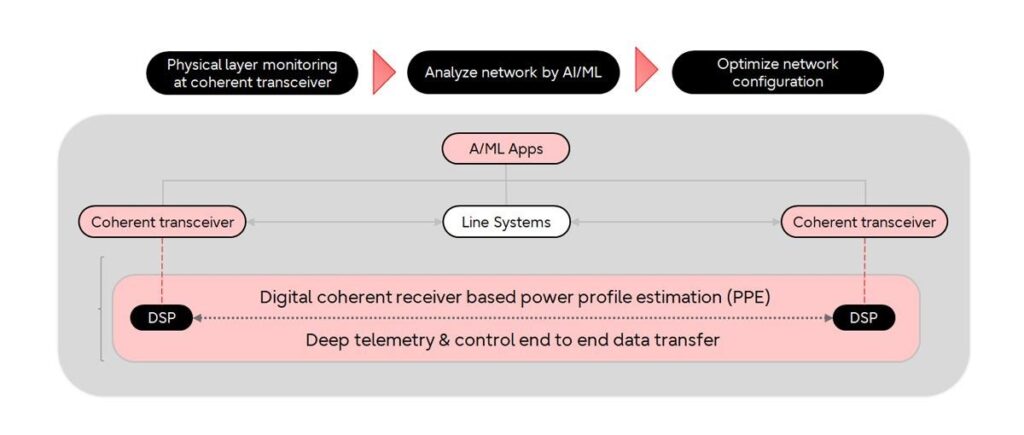
End-to-end smart monitoring for AI-driven fully automated optical networks
What Can We Expect Next?
The innovation curve in optical networking is steep and accelerating. Pluggables at 1.6Tbps are on the horizon, with 3.2Tbps in planning phase. Multi-rail line systems supporting dozens of rails within a single chassis promise massive capacity with minimal footprint. Liquid cooling will become ubiquitous, extending from transponders to pluggables to line systems.
Looking beyond current deployments, the next decade of optical networking will introduce new technologies with deep sustainability potential:
•3D-integrated DSP and photonics for multi-tera rate transmission.
•Liquid-cooled ready transmission and multi-rail line systems with tens of rails per chassis.
•AI-assisted chip and component design, along with novel materials for optimized optical systems.
•Multi-band operation (O, S, C, L, U) to expand usable spectrum.
•Multi-core and hollow-core fiber to dramatically increase capacity per cable.
Each of these innovations focuses on improving power per bit while minimizing environmental impact.
On the Road to a Sustainable Future
A sustainable optical transport network is achievable through coordinated advances across CMOS scaling, photonic integration, miniaturization, multi-rail architectures, advanced line systems, and liquid cooling. Automation and AI amplify these benefits by minimizing operational waste.
Sustainability is no longer an optional attribute; it is a strategic imperative for network operators. The operators who embrace high-integration, thermally efficient, power-optimized technologies, supported by intelligent automation, will lead the next generation of optical transport and will collectively establish a sustainability-focused roadmap for the future.
RESOURCES
1. “Supercomputer Fugaku.” Fujitsu, https://www.fujitsu.com/global/about/innovation/fugaku/
2. “Terabit optical networking.” Fujitsu company 1Finity, https://www.fujitsu.com/us/products/network/products/1finity-ultra-optical-system/index.html
3. “Orange completes successful trial of Fujitsu 1FINITY optical transport solution”, Fujitsu company 1Finity, https://www.fujitsu.com/global/about/resources/news/press-releases/2025/0604-01.html
4. “Brilliant optical networks for the AI era”, Fujitsu company 1Finity, https://www.fujitsu.com/us/products/network/products/1finity-p300/

Author: Courtney Burrows
Courtney Burrows is the Executive Editor of Greener Data and Executive Vice President of Marketing and Sustainability at JSA, where she leads content strategy across PR, marketing, and media initiatives for the global digital infrastructure industry. With more than 20 years of experience — and over a decade dedicated to data centers — she curates expert insights focused on data center sustainability, innovation, and the evolving demands of an AI-driven world.