


Lead Analyst: Mary Allen, InsightaaS & JSA
Report Contributors: James Beer, Qu Data Centres; Bruno Berti, NTT Data; Tate Cantrell, Verne; Michael Donohue, Oklo; Yury Lui, Digital Realty; Peter Panfil, Vertiv; Martin Reed, CBRE; Augustin Roca, Nautilus Data Technologies; Dave Sterlace, Vertiv
This chapter is an excerpt from Greener Data: Volume Three, launched on Earth Day 2026. Featuring perspectives from 75+ sustainability leaders across the digital infrastructure ecosystem, the full book is available now on Amazon.
Imagine data centers in a polar orbit that maintains a consistent angle to the sun to capture uninterrupted solar energy,1 or a true ‘moon shot’ where lunar-based facilities rely on solar power and naturally cooled solid-state disc drives.2 Consider the benefits of using data centers as residual power generators by harvesting wasted wind energy created by artificial air flow from facility fans,3 or the potential for two thirds of new data center energy demand to be met with next-generation geothermal techniques that extract continuous power from deep within the Earth.4 Weigh the efficiency and performance gains promised by the deployment of photonic cold plates a thousand times smaller than the width of a human hair that can direct cooling lasers at chip hotspots to regulate chip temperature and significantly lower power consumption,5 or the use of quantum computing, which is reported to be 100 times more energy efficient than the typical supercomputer.6 What do these futuristic solutions have in common, and what is driving this diverse and wonderous spectacle of engineering innovation? In each case, these inventions address critical resource requirements in data center power and cooling – while improving the facilities’ environmental footprint.
What’s Driving Innovation?
Explosive Growth in Data Center Demand
In the aftermath of the COVID pandemic, data center organizations across the globe engaged in a well-publicized contest of commitment to decarbonize their operations. Today, the explosion of demand for digital services is engendering a different kind of competition. The AI revolution has kicked off a race to build more capacity in ever larger facilities. In the US, which hosts close to 46% of data centers worldwide,7 the federal government has announced significant support for AI data center build, bolstered by private sector investment.8 In the summer of 2025, construction spending on data centers in the US was up 366 percent from 2021 levels – by the spring of 2022, a spending rate of a million a month was achieved.9 In that year, SoftBank, OpenAI, Oracle, and MGX announced their joint intention to spend $500 billion in the US over the next four years on new data centers.10 Other jurisdictions have echoed this remarkable investment in new data center capacity as companies and countries come to view digital infrastructure as the key to future productivity and competitiveness; McKinsey estimates that capital expenditures on global data center infrastructures will reach close to US $7 trillion by 2030.11
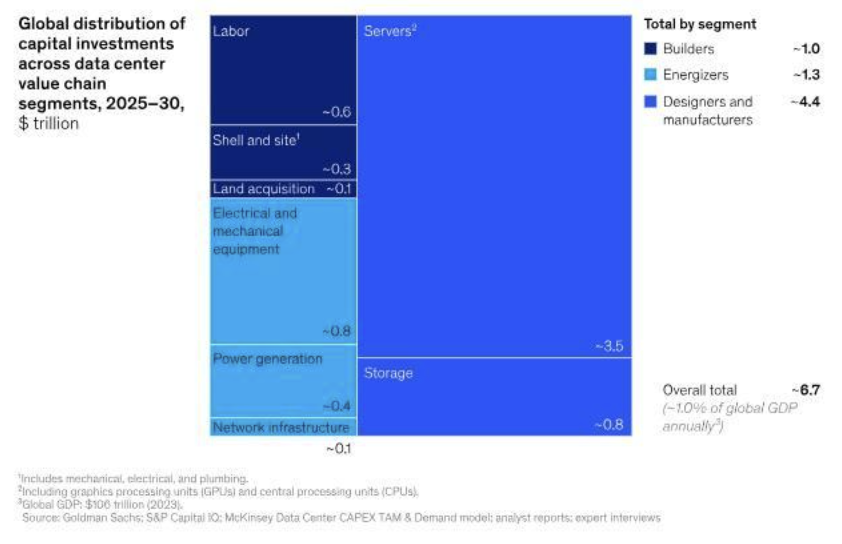
Figure 1. $6.7 trillion of capital expenditure will be cumulatively deployed in data center infrastructure through 2030. // Source: McKinsey and Company. The data center balance: How US states can navigate the opportunities and challenge.
But how can various regions deliver the power needed to feed this building frenzy? Investments in energy infrastructure have also grown – an increase of 67% in the US since mid-2018, for example – however, growth in the electricity sector has not kept pace with new requirements.12 According to Goldman Sachs, data center power demand will grow at a compound annual growth rate of 15% from 2023-2030, with the industry consuming 8% of total US electricity output by 2030 (up from ~3% today),13 which will be challenged by the adoption of EVs, the decarbonization of heating, and increasing data center demand. For the individual data center business set on expansion, the consequence is a long queue to connect to the local grid due to pressure on grid capacity, and delay from local permitting authorities anxious to ensure community power supply. In busy US data center markets, such as Virginia and Texas, power companies are managing an upsurge of requests for new data center connections by charging significant fees just to apply for grid resources to handle additional load.
In the IT world, increases in overall capacity demand are being driven by the development of new technologies. AI is forcing unprecedented change that traditional sustainability techniques and approaches, such as rightsizing IT and facilities equipment needs, virtualization, waste reduction, or even reduction in PUE will be hard pressed to address. To support new technology deployed for processing AI and adjacent storage and networking infrastructure, data center operators are having to rethink the way data centers work, as power and cooling needs reach critical levels. Powerful new chips and increased server densities demand revolutionary approaches to current data center design and future needs. Advanced NVIDIA GPUs, for example, can consume three kilowatts of power, rivaling the energy consumed in a conventional server rack. Designing for ten-fold power increases today, operators will be challenged by long term planning that must contend with the ongoing evolution of technology and equipment. In a recent study of top AI data centers, researchers have concluded that by 2030, the leading AI data center could house two million AI chips, cost $200 billion, and consume nine GW of power.14
Powering New Potential
Ensuring that there are enough electrons on the grid to service growing data center energy demand will challenge operators; delivery to the right place at the right time is an even larger concern. The construction of huge AI facilities has created an immediate need for ever larger blocks of power. The 130 MW campuses built four years ago are now supplanted by plans for facilities in the multiple hundreds of MW, even GW plus deployments. 15 This kind of scale means that powering new facilities with green energy – a critical requirement for participating in the energy transition – is beset with problems. Distributed computing also strains the ability of aging grid infrastructure to meet the needs of industries undergoing electrification and digitization. Edge computing, for example, has shifted power demand outside traditional data center markets, such as London, Paris, Frankfurt, or Amsterdam in Europe, and beyond dense markets in the US – pushing local grid operators who must generate and also distribute the required power.
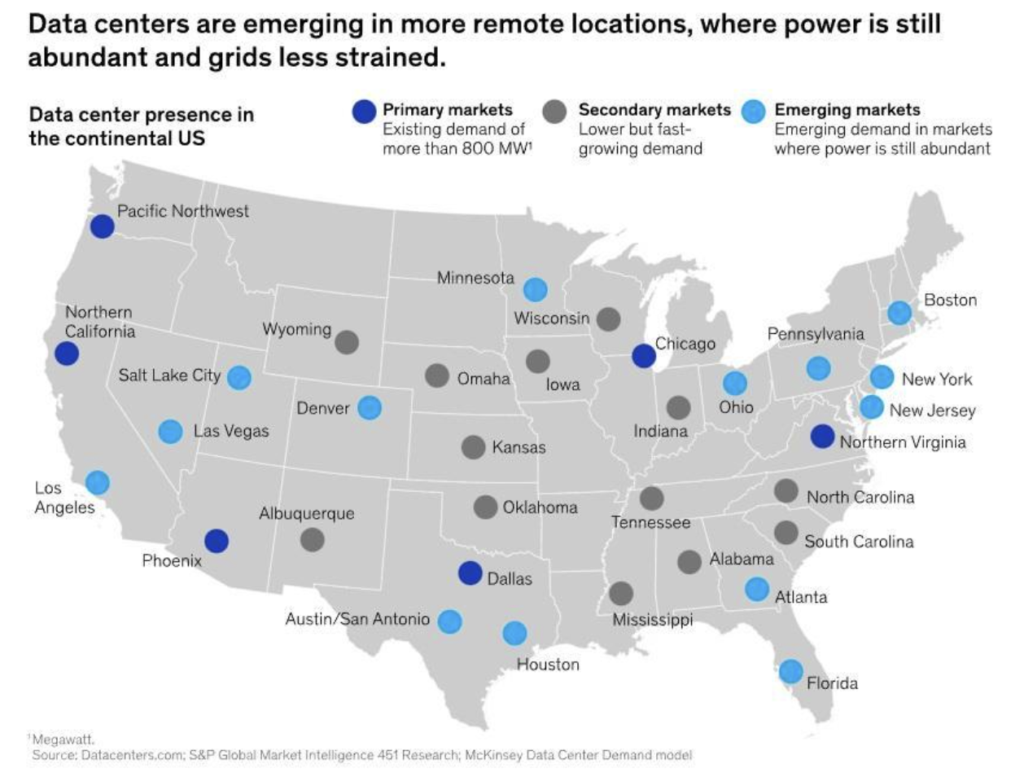
Figure 2. US Data center markets by power availability
Accessing Grid Power
For grid and data centers operators looking to create access to more and cleaner power, a key stumbling block is energy management. The massive power outage in experienced by Spain and Portugal in the spring of 2025, for example, was attributed to a local utility’s inability to manage rapid voltage variation in the transmission of renewable power.16 Better storage is widely viewed as a solution to address issues with renewable energy intermittency and power distribution in grid infrastructure. Another approach that is gaining some currency is IT-enabled flexibility power markets, or platforms that can adjust power generation and consumption to balance grid supply and demand. Essentially markets that rely on dynamic pricing and competition between flexibility providers to drive energy trade, these markets aim at managing grid fluctuations to prevent blackouts or shortages that may be associated with the introduction of renewable energy sources. Currently under development, in the EU region in particular, flexibility markets will benefit from design for different use cases, more clear regulatory standardization for what are now essentially local markets, and better definition of contractual requirements, revenue benefits, and cost management.
For their part, data center operators are developing multiple strategies to ensure better access to energy sources and power assets. To support digital service delivery, Florida-based Hut 8 operates its own power plants, focusing on the acquisition of critical energy assets (grid interconnects, powered land, and other electrical infrastructure). The company has also created corporate development teams that comb the continent to locate stranded utility power. Typically, unused energy is not GW level, but in the 25-50MW range, adequate for use by operators who can rethink workload sizes. As the market shifts from AI training to AI inference, these smaller energy footprints may be used by smaller facilities in edge computing configurations.
Hitachi Energy has also noted a shift towards data center strategy to secure electrical infrastructure. A manufacturer of substations, and power and distribution transformers, Hitachi Energy has more data center customers delivering their own substations, with higher voltages (250-300 kilovolts, up from 100 kV) that are more characteristic of transmission equipment; the goal is to establish higher voltages to create connections that more easily access reliable grid power.
Grid Interactivity
Stress on the grid due to extreme weather conditions, aging infrastructure, and explosive increase in energy demand are introducing risk to power supply in many regions. In Texas, for example, blackouts from storms in 2020 resulted in 2025 legislation that allows the local utility (ERCOT) to cut power to data centers and other non-critical industrial consumers in times of emergency.17 Today, grid stability is also tested by the rapid power fluctuations of AI training – load swings in tens or more of MW in hundreds of milliseconds that can occur in some cycles. In dynamic AI settings, a 30% power draw can jump to 160% load, down to 100% load and then back to 30% multiple times a second. To address this issue, operators are beginning to have conversations around the use of generation level/utility level power quality solutions within data center settings. These might include use of STATCOM (Static Synchronous Compensator), for example, a fast-acting power electronics device that provides dynamic voltage support, to maintain stable voltage levels during disturbances or fluctuations in data center environments.
The Texas legislation and other programs now support data center participation in voluntary demand-response programs that would see facilities act less as ‘consumer’ and more as ‘prosumer’ of energy. This might involve workload shifting to times of lesser energy demand and to regions experiencing less demand, or a switch to onsite generation (batteries, generators) to help manage grid supply issues during times of peak consumption, in emergency situations, in the integration of intermittent renewable energy sources.18 Other techniques that offer potential in an AI era might include checkpointing AI training runs every five minutes or so to run only storage and key networking components to avoid peak demand. This would eliminate 90% of load, reducing direct grid interaction and stress from AI fluctuations, or in times of grid emergency. Data centers that participate in this kind of action may receive preferential treatment in terms of power supply or rates.
Staffing challenges (ex. night shift to support solar generation), regulatory limitations on the amount of time generators can be used,19 and the cost of carbon scrubbing equipment, when data centers move off grid for short stretches, can be significant but so can the benefits of grid interactivity. During the California heat wave in 2022, NTT Global Data Centers switched to generator power, taking 30 MW of power off the grid, enough to power 30,000 homes.20 A recent study estimates that by limiting power drawn from the grid to 90% of the maximum contracted for approximately a day per year, data centers could unlock 76 GW of capacity in the US.21 By moving away from traditional models that see the data center simply as a load on the grid with diesel backup, data centers can unlock opportunities to access power that is actually available due to reduction in peak demand. Acting as additive to grid stability, they can unlock potential to reduce cost and carbon.
Behind the Meter – Onsite Generation
Transmission constraints, coupled with density of load at a campus level, have led many operators to consider developing prime power generation onsite. In some instances, business pressure to quickly access as much power as possible is leading companies away from carbon reduction initiatives. Elon Musk’s xAI data center in Memphis, which runs on unpermitted methane-gas powered generators that impact air quality is only one, more public example.22
In other cases, driven by climate targets and power-hungry AI requirements, operators are looking towards nuclear technology as a source of carbon-free power generation.23 While large scale nuclear is experiencing some resurgence – Microsoft’s PPA investment is restarting one of the shuttered reactors at Three Mile Island – the data center industry has placed most focus on small modular reactors (SMRs), which take less time and capital to deploy. Data center interest in SMRs launched back in 2023 with NuScale’s agreement with mobile data center provider, Standard Power, to supply up to 12 SMRs for 2 GW at two separate sites.24 Since then, Google has signed a 500 MW deal with nuclear startup Kairos, AWS has announced three SMR projects, including purchase of the nuclear-powered Cumulus data center in Pennsylvania from Talen Energy, and Oklo Corp. has announced agreements with data center operator Switch, colocation provider Equinix, and Prometheus Hyperscale.25 The appeal of SMR technology lies in the ability to mass produce components, which would allow consumers to avoid the cost overruns and delays involved in building industrial-scale nuclear assets. In addition to carbon free, baseload power, SMRs offer more ready access to energy resources.
The fast fission solution offered by Oklo takes this one step further, as it uses spent nuclear fuel from other reactors as its fuel source to address concerns over the storage of nuclear waste, and to avoid the carbon cost associated with new extraction. One Oklo estimate holds that if all the nuclear waste ever produced by the US was gathered together, it would occupy the dimensions of a soccer field 10 meters high; if this was recycled, it could generate clean power for the US for the next 100 years. Deployment of SMRs at data center sites would allow operators to remove diesel generators and, with some battery support for other renewables, move quickly to achieve net zero pledges. Today, Oklo envisions direct-connect Powerhouses that would bring on data centers in 100 MW chunks, with an anchor tenant of 75 MW to support the business case for deployment. In the future, it will look to supply excess power to data centers in proximate locations, or even to the grid, when utilities are ready to accept this form of green energy.
Projections for nuclear capacity are optimistic. While permitting for new builds is now a source of delay, a relaxation of permitting requirements advanced by a pro-nuclear US administration – ex. reducing the distance required between nuclear facilities and populated areas – should shorten the time horizon for the advance of SMRs to support data center environments.26 Most estimates point to 2030 as the earliest date for live deployment.
Renewable sources of energy can offer greater potential to address immediate power shortages. Solar and wind farms, for example, can be developed in approximately half the time it takes to build nuclear and gas plants; the average completion time for a solar power plant is a year and a half. Delivering electricity with lower carbon emissions than power generated through the burning of fossil fuels,27 renewable energy sources are a good choice for data centers looking to reduce their environmental footprint. Typically, data center operators engage with renewables via PPAs or RECs, which are readily available in the marketplace, rather than direct deployment of solar, wind – and now nuclear – assets. Investments by the hyperscale community, in agreements such as Google’s recent US$3 billion purchase of 3 GW of hydropower from Brookfield Asset Management,28 have helped propel the data center industry to rank as the largest purchaser of renewable resources. RECs provide means for smaller companies to achieve sustainability targets.
The intermittent nature of renewables means their adoption on premise is dependent on battery technologies. Battery Energy Storage Systems (BESS) are designed to manage integration with renewables, while fuel cells, lithium-ion batteries, and even flow batteries can provide the clean energy bridge needed to ensure uninterrupted operation. Capable of discharging electricity for days or even weeks at a time, flow batteries can act as a clean, reliable source of energy to manage issues with continuous power in renewable installations.29
To ensure continuous, reliable power that is also sustainable, many operators are replacing diesel generators with those that run on alternative fuels, such as HVO or hydrogenated vegetable oils created from waste in cooking or other innovative sources of sustainable energy, such as synthetic e-Fuels derived from green hydrogen and carbon dioxide.30
Power Delivery – Efficiency Inside the Walls
In a traditional data center, the utility delivers alternating current (AC) power to the facility, which is then stepped down to a lower AC voltage. This lower-voltage power is then routed to IT racks, where power distribution units (PDUs) convert it to direct current (DC) power for consumption by IT equipment. When infrastructure contains GPUs, power is converted again to a lower DC voltage used to power these advanced chips. These transformations are necessary as DC power is used more efficiently by electronic devices. Higher voltages are another means to increase the efficiency of power utilization within the data center, as they allow for delivery of the same amount of power via a lower current, and thereby reduce resistance losses that convert electricity into unwanted heat.31
AI racks often require higher-voltage systems, and some operators are now planning jumps to 400, 800, or even 1,500 volts DC. While the energy savings associated with this approach may be less than anticipated – a single digit percentage, rather than 20% expected by designers – it is possible, using DC, to deliver a huge amount of capacity to a single cabinet, the optimal configuration for GPUs that require proximity to communicate, saving the cost of powering networking resources outside the cabinet. To deliver high-voltage DC into 600 kW or 1.5 MW cabinets, voltages would need to be + or – 400-volt DC. With lower voltage DC, it may even be possible to remove the UPS and rely instead on battery backup units (BBUs) that are directly incorporated into the compute rack.
Vendors have begun to develop for this new paradigm. For example, in partnership with NVIDIA, Vertiv has created the 800V HVDC solid-state transformers to convert 13.8kV AC grid power into 800V DC at the data center perimeter, and IT rack-level DC converters and backup systems that transform power to the lower voltages needed to run GPUs.32 Other vendors have taken alternate tacks; liquid-cooled power systems are water-cooled electrical cables that can deliver more power to the same footprint as in traditional systems while more effectively removing heat.33 In most data centers today, AC infrastructure is well established with appropriate safety standards in place. Use of DC will require additional work to develop standards for DC-only wiring, grounding, arc flash, and interrupted capacity. Cost may also come into play; a traditional data center PDU may use a simple breaker that one could use in a house (average cost between $5 and $20 for common breakers found in basic PDUs), while a DC power demo for a data center used breakers that were 4x as wide, and cost $100 per unit. Cost, efficiency, and environmental savings may prove difficult to resist; however, according to NVIDIA, the new 800V DC platform can improve efficiency by 5%, significantly reduce copper use, reduce maintenance costs by 70%, lower cooling requirements, and cut the total cost of ownership by 30%.34
High-Density Sustainability Benefit
Varying only in degree, the power-hungry profile of AI infrastructure is recognized by virtually all industry observers, who also comment on the lightning-fast evolution of new use cases for the technology. But less well publicized is a surprising sustainability benefit of deploying high-density infrastructure. Greater overall energy efficiency in the AI data center, as compared to traditional operations, is demonstrated through a key metric. According to a recent study on leading AI supercomputers, computational performance per watt has doubled every nine months (a rate of 2.5x per year) from 2019 to 2025, due to the introduction of more GPUs and more powerful GPUs.35
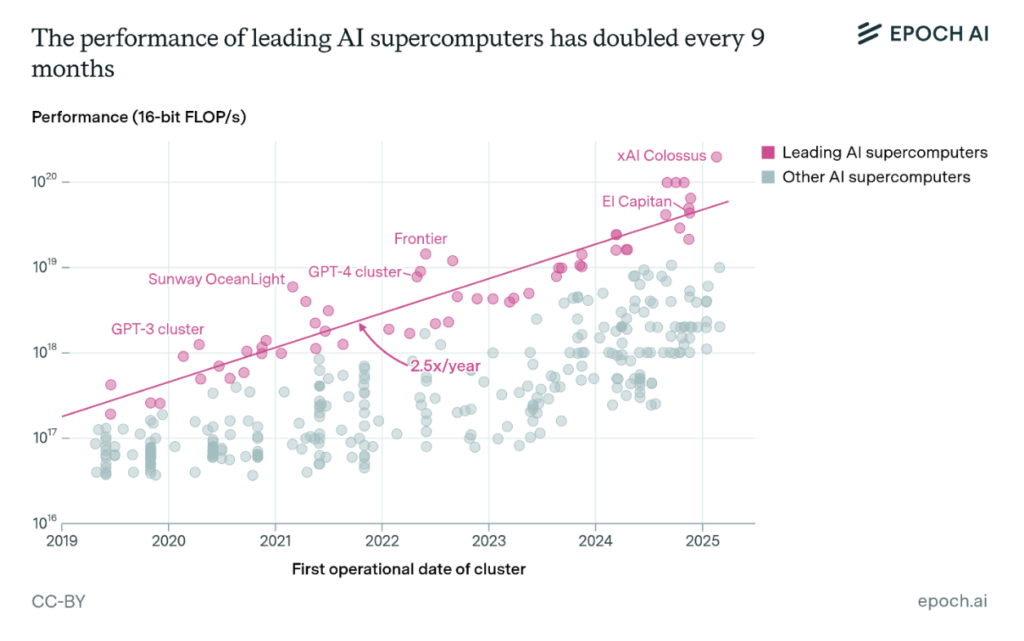
Figure 3. Computational performance of leading AI supercomputers // Source: Epoch AI
So while a GPU typically draws more power than a CPU, for highly parallel, compute-intensive workloads (e.g., matrix multiplications common in AI and HPC), it can deliver an order-of-magnitude higher throughput and often better performance per watt. Viewed from a physical space perspective, the pod of GPUs may consume significant power, but they do not require as much raised floor, steel, copper, or concrete, which each carry Scope 3 impacts, as would traditional infrastructure to complete equivalent tasks. Whether these benefits will be enough to address the increasing environmental impact of massive growth in high-density data center build will depend on ongoing innovation across power and cooling systems.
The GPU Arms Race
Data center operators looking to leverage the potential environmental benefit of high-density infrastructure may achieve this, provided a fundamental principle of IT sustainability is in place – that is, avoid overbuild. Today, however, the opposite is more common practice as a GPU ‘arms race’ is underway, with operators buying chips and installing as many teraflops of NVIDIA cards as possible, resulting in huge swings in utilization rates. Due in part to current low market rates on GPU rentals, the overbuild of GPU infrastructure has led to the inefficient utilization of deployed hardware and idle equipment. As more data centers come online and as competition for compute power to support innovation intensifies at the company and even geopolitical level, greater use of fractional GPUs or better virtualization (80-90% utilization is optimal) may help the industry to improve efficiency and utilization.
Next Generation Cooling
Data Center Cooling Complexity
Linked symbiotically with power – the more power you use, the more cooling you need – data center cooling is a growing problem for data centers looking to ensure reliable and responsible operation. If cooling requirements vary depending on customer applications and the infrastructure that is built to support them, customer use cases and technologies to support data dense applications continue to evolve at a breakneck pace. The 4-5 kW rack with perimeter cooling has given way over the past decade to an 8-30kW rack average for data centers today,36 and to the 600-kilowatt rack with unique cooling needs. These exist alongside low power workloads (networking, firewalls, security, storage) that must also run in the facility alongside HPC, AI, and other energy-intensive workloads. For data center designers and operators who must plan to fulfil peak requirements, this diversity spells cooling complexity that is typically addressed today through ‘build to suit’ rather than the ‘cookie cutter’ build of the past. A heterogeneous approach, combining some air and some water, to cool environments housing low density, a bit of medium density, and a bit of high-density infrastructure, poses a new set of design challenges.
A rule of thumb for environments that support full-on generative AI or compute to process large language models is a hybrid cooling approach consisting of 80% liquid (often cold plate to GPUs), and 20% air cooling for standard CPUs in conventional configurations. This focus on liquid is due to the relative efficiency with which different media can transfer heat. Water, for example, is more dense than air, and so has a much higher heat capacity than air: it is ~4× higher per kilogram, and—because it’s far denser—thousands of times higher per unit volume. As a result, liquid cooling can move large heat loads with much lower flow volumes than air.
In addition, liquid is more efficient from a power perspective. In typical implementations, air cooling consumes 0.5-1.2 kW per kW of IT load, while liquid cooling reduces consumption to 0.1-0.3 kW per kW of IT load.37 At a PUE level, the liquid cooling advantage translates to 30% higher efficiency when liquid is used to cool the data center as opposed to air.
This liquid advantage is critical, given the rapid development of powerful new chip technologies that are purpose built for supercomputing and AI with thermal design power (TDP) numbers that now exceed 1,000W, and which may double or triple the in next chip generation.38 The heat generation profile of new chips requires the use of liquid that is colder (at the plate level) – in the range of 20 to 30 degrees C; however thermal resistance and heat absorption as liquid transits through liquid cooling systems (through chillers or CDUs (coolant distribution units)) can raise temperatures 10 degrees higher or more, requiring additional cooling.
Mitigating Water Resource Impact – Flavors of Liquid Cooling
Liquid cooling’s effectiveness in addressing heat challenges associated with new infrastructure technologies and its ability to reduce energy consumption and associated carbon emissions offers new potential for improved data center efficiency. With the accelerated construction of new facilities in today’s market, however, water usage looms as a resource issue that begs renewed focus on cooling innovation. As not all water used in data centers is returned to the water cycle, this is a particular challenge in water scarce regions, where close to two thirds of data centers have been built since 2022.39 Recent research estimates that by 2027, global AI demand will account for withdrawal of 4.2 – 6.6 billion cubic meters of water, or half the current withdrawal of the UK.40 And in a new report, the IEA estimates that water consumption by the data center industry – or water withdrawn, but lost through evaporation, and hence not returned to the original source – could rise to 1,200 billion liters annually.41
A data center’s total water footprint is comprised of water used onsite, water consumed by the utility that supplies the facility with power, and water used in the manufacture of server chips, with onsite usage accounting for the majority.42 At the site level, there are two phases of cooling that may involve water; heat capture in IT server rooms via air systems, direct-to-chip systems or immersion cooling; and heat rejection to an ultimate sink, which may involve dry coolers, chillers, evaporative towers, seawater/lake exchange or heat capture and reuse.
In phase one, liquid cooling for heat capture in high density environments is now typically closed loop, meaning the system recycles water resources. Liquid cooling that delivers coolant directly to GPUs and CPUs through direct liquid-to-chip (DLC) or immersive cooling systems (that immerse the server in liquid) are more effective means of dissipating heat than air, typically closed loop to reduce water consumption, and favored by operators needing to cool power-intensive environments. While challenging to implement at scale, consensus is emerging around the benefits of direct liquid-to-chip cooling in terms of efficiency and water conservation. A recent microfluidic innovation involves etching very thin channels directly onto the GPU and filling them with liquid coolant (in contrast to cold plates that sit on top of the chip). When combined with AI that detects heat signatures and directs cooling to hotspots, Microsoft claims this new approach can reduce the maximum temperature rise of a GPU by up to 65 percent.43
Closed loop or immersion systems may also use dielectric fluids rather than water, but the most popular choice of medium for heat exchange is now a propylene glycol/water mixture. This mix avoids risk to human and environmental health that could arise through leakage or waste disposal of dielectrics that contain ‘forever’ chemicals; research today is focused on the development of fluids that are PFAS free.
Phase two – heat rejection – may be more water dependent, and various cooling technologies in this stage will have different environmental impacts. Water chillers that cool IT server rooms to maintain optimal ambient temperatures often rely on air cooling through water evaporation, a method that is open loop and water intensive. In each approach (evaporative, direct-to-chip, or immersion), a heat exchanger (a chiller or cooling tower) may be needed to capture hot air or water from the cooling process to transfer heat from the server room to the building’s cooling system, or to the exterior.44
An emerging solution involves using a natural body of water as a heat sink. Pumping cooled water from a nearby lake through the server room and then releasing it with only slightly elevated temperatures that are easily dissipated, reduces the delta T between source temperature and the cooling distribution point, increasing the efficiency of water cooling and vastly improving the data center’s sustainability profile, as compared with traditional approaches, such as the evaporative tower that might consume millions of gallons of potable water on a daily basis. Similar in kind is the deployment of seawater cooling, where a closed loop cooling system circulates seawater through heat exchangers and returns heated seawater to the ocean. While reducing reliance on limited freshwater resources, this approach supplies virtually unlimited cooling capacity – assuming the facility is located proximate to the seaside.45 The data center operators’ decision to deploy one or other cooling technologies depends on factors such as workload profile, local climate, availability of water and power resources, and the data center’s sustainability goals.
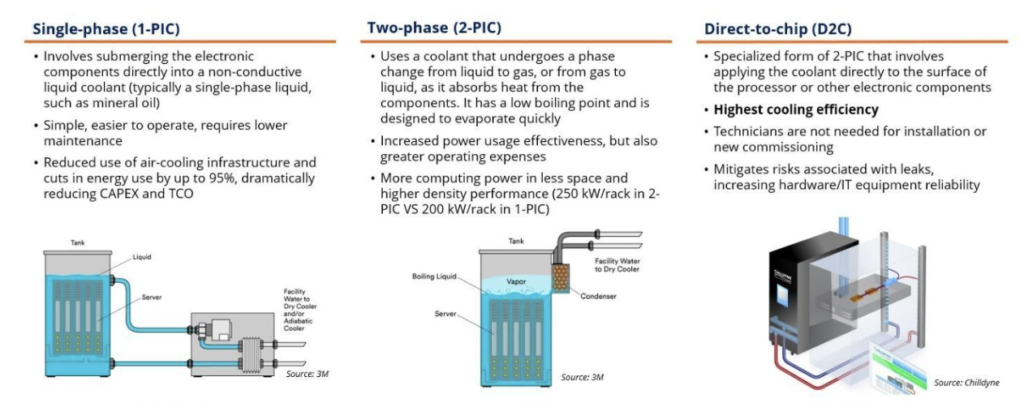
Figure 4. Immersion Cooling Technologies // Source: The Cleantech Group
From a sustainability perspective, cooling technology in high-density infrastructure can contribute to an improved PUE. With direct-to-chip cooling, for example, it may be possible to remove traditional chiller systems, reducing the amount of mechanical power that is needed, enabling its redirect to IT systems. In high-density AI environments, efficiency may also be gained by spreading the thermal load across three chillers rather than pushing two to 90% capacity. By utilizing the additional evaporator surface area, the system can accept higher return-water temperatures while reducing thermodynamic lift, allowing the compressors to operate at a significantly lower kW/ton ratio. In addition, mechanical systems may be optimized through the use of data center technologies, such as DCIM, DCP motors, etc. that will allow the operator to take full advantage of available power. In an AI era, rapid power consumption means that mechanical capacity is rarely in excess; while operators formerly might ramp to 40 percent utilization of systems, in AI environments, the data center might ramp to 80% utilization within the first few months of deployment.
Optimizing Cooling Infrastructure
A key principle in design for sustainability is waste reduction. In the data center, this may be achieved through a number of tactics. On the thermal side, heat recovery or heat reuse can have dramatic impact on total energy losses. Another approach is to avoid overprovisioning – the tendency to overbuild cooling to address peak demand or even next generation chip technology, or to layer liquid cooling capacity on top of existing air cooling. Good design, where infrastructure is built to meet the needs of specific applications with defined targets can help, even if average cooling capacity built per rack must still account for unanticipated peak demand. In the ‘AI factory’, there is potentially more opportunity to right size data center cooling needs. Designers may begin with estimates of chip requirements, based on the number of GPUs relative to CPUs, as well as rack and pod sizes, to develop a dynamic power/cooling mockup that estimates how much liquid vs. air cooling might be needed. Behavior modelling is another powerful tool that can be used to create, and learn from, ‘what if’ scenarios in infrastructure design.
Beyond the data center, OEMs are engaged in chip design to support lower precision math calculations that can reduce AI computational loads, and for rack-scale architectures that can boost efficiency.46 In some cases, chip makers are working with equipment suppliers to co-develop solutions that optimize the delivery of power and cooling as a symbiotic whole. For example, throughout 2024 – 2025 power and cooling infrastructure provider, Vertiv, worked with NVIDIA to understand densities on a per rack basis and has created dozens of reference designs to address existing and future compute deployments – creating new products and services along the way. The goal has been to take existing cooling infrastructure that may be supporting eight pods of 130 kilowatts and enable this to support one dense pod at 10 megawatts.
Assuming operators prioritize efficiency gains along with pure AI performance, these kinds of advances may support the achievement of sustainability goals. Typically, AI is viewed as a source of climate impact; however, innovative operators are also deploying AI to resolve issues in the data center. For example, the team at Digital Realty is using AI to optimize white space, water consumption, and digital infrastructure overall. In partnership with Ecolab, a specialist in water, hygiene, and infection prevention solutions and services, Digital Realty has piloted an AI-driven water consumption optimization system in 35 of its US data centers. Described as ‘a closed loop with some intelligence behind it’ the system uses reinforcement learning to provide insights into how water is used. It focuses on anomaly detection – temperature fluctuations that diverge from benchmarks – and water usage patterns influenced by factors such as water quality, the impact of workload, and equipment efficiency. When fully implemented, Digital Realty looks forward to the system delivering a 15 percent reduction in water use.47
Armed with AI and other tools, new thinking on cooling systems is producing many evolving options for data center operators. However, another wave of innovation will be necessary to deliver these systems at scale. Building a 60 MW facility that is fully liquid cooled may require larger CDUs, new design on stainless steel piping, redundancy systems and the manifolds to span that, or new engineering to connect DLC (direct liquid to chip) to a secondary liquid loop. Operational considerations in immersion cooling may include maintenance challenges (how do you access a server that is fully immersed?), or issues around leakage and disposal of dielectric liquids that are safe (non-conductive) and highly efficient, but can have levels of toxicity or GWP (Global Warming Potential) that require special handling.
Modularity
This issue of scale is being met today with new products and designs aimed at translating bespoke approaches to modular solutions. For example, cooling specialist Nautilus is building more efficient CDUs with more cooling capacity and firmware that analyzes sensor data to better manage water, flow, and leaks. These are based on the Redfish standard for managing data center cooling equipment, a protocol that enables monitoring and reporting on coolant flow and the thermal status of the system, to better align cooling with IT-based activities. These larger CDU units may remove the need for complex systems with multiple kinds of traditional cooling equipment (chillers, towers) that can drive energy consumption. Modularization produces economies of scale at the production level, which can positively impact Scope 3 metrics, but also drives efficiencies around deployment; approximately 70 percent of the ‘fit out’ of the Nautilus CDU units occurs in the manufacturing facility to speed and ease deployment at the data center site.
Scaling Innovation – Key Recommendations
For data center operators looking to push sustainability in power and cooling systems, innovation is delivering multiple exciting options – in space, on the ocean floor, and here on earth. But implementation can present challenges that the industry will need to address to ease deployment, and inspire ongoing new thinking on sustainability issues. Key insights to drive progress on this front include:
Standardization – standardization is needed in several areas, ranging from safety protocols for DC power distribution to optimal water temperatures in cooling systems. Standards provide the basis for change, a solid foundation on which to innovate design that can facilitate broader market adoption of new technologies. Bespoke solutions can address unique user needs, but may not be optimal from cost or sustainability perspectives. Standardization provided as a guide rather than rigid specification for manufacturers and operators would be most beneficial.
Meaningful Energy Efficiency Metrics – going forward, meaningful, comprehensible energy efficiency metrics that are relevant to AI workloads will be increasingly important. One example is the EU’s Ecodesign for Sustainable Products Regulation (ESPR), an energy labelling regulation for hardware devices that is intended to work in tandem with the AI Act, which measures the energy efficiency of AI software itself. Ops teams have embraced practical efficiency techniques to lower PUE, but integrated metrics that encourage IT teams to also push efficiency efforts in tandem with facilities operators will drive further progress on sustainability.
Chief Sustainability Officers – while the notion that energy efficiency initiatives may compromise reliability and redundancy has been effectively addressed through IT solutions, a mindset that hesitates to prioritize sustainability lingers in data center culture. A new generation of leadership that is more open to the opportunity sustainability offers is a source of optimism; however, a top-down approach involving the creation of Chief Sustainability Officer roles to prioritize sustainability initiatives at the executive level is crucial for overcoming internal challenges and achieving sustainability goals.
Renewed Effort on Sustainability Strategy – based on efficiency innovation and a commitment to the use of renewables, the data center industry has long enjoyed a position of leadership on sustainability. But a ‘first mover’ mindset in today’s competitive AI-fueled market, the rapid scale of power-dense infrastructure deployment, combined with a de-emphasis on environmental rigor in political/regulatory regimes, threatens this status. The promotion of concrete sustainability strategies may help ensure that the industry continues to push forward, maintaining a hard-won position of sustainability leadership.
Recharged Focus on Sustainability Messaging – increased knowledge sharing through public case studies and other materials, can have huge impact on the adoption of new sustainability technologies and approaches. The energy-hungry data center is a ubiquitous target in public media today. But broader awareness building and communication on the positive contributions that the data center industry has made and can make going forward to environmental challenges can encourage industry players to maintain sustainability commitments.
Ecosystem Development – progress on sustainability is essential to the continued health of the data center industry. Today, this progress is dependent on collaboration between an increasing number of stakeholders, including data center owners/operators, grid operators, IT, financial and facilities managers within the data center, OEMs who must now work with operators to optimize solutions, academic researchers, innovation labs, regulators, governments, and local communities that can benefit from more depth understanding of data center operations and opportunities.
Innovation Can Be Doing the Right Thing – planning that calls for advance investment to responsibly accommodate growth will be critical to a more sustainable future. For example, with connectivity or power cables in place to service future demand, data centers may fit out infrastructure modules as demand increases, and avoid running capacity today that addresses future requirements. Design and value engineering that moves beyond price to enable modular, flexible, and expandable systems that can accommodate green innovation (renewables, heat reuse) can deliver sustainability, efficiency, and cost benefits.
RESOURCES
1. ASCEND (Advanced Space Cloud for European Net Zero Emission and Data sovereignty) is a feasibility study led by Thales Alenia Space on behalf of the European Commission designed to demonstrate the technical feasibility and the environmental benefits of deploying large capacity data center in space. Project leaders anticipate launch in 2030.
ASCEND Cloud in Space. https://ascend-horizon.eu/
American startups with similar objectives include Starcloud, and Eric Schmidt’s Relativity Space, while in China, ADA Space launched 12 satellites in 2025 to begin building the world’s first orbital supercomputer.
Eric Schmidt apparently bought Relativity Space to put data centers in orbit. ARS Technicha. https://arstechnica.com/space/2025/05/eric-schmidt-apparently-bought-relativity-space-to-put-data-centers-in-orbit/
Andrew Jones. China launches first of 2,800 satellites for AI space computing constellation. Space News. May 2025. https://spacenews.com/china-launches-first-of-2800-satellites-for-ai-space-computing-constellation/
Starcloud will rely on 24/7 solar energy and radiative cooling, while avoiding permitting constraints on Earth. Starcloud | Data centers in space.
2. In March 2025, Florida-based Lonestar Data Holding launched “Freedom Data Center,” the first moon-based facility on a SpaceX rocket.
Emma Woollacott. BBC. The plans to put data centres in orbit and on the Moon. April 2025. https://www.bbc.com/news/articles/cjewvpkw7weo
3. One data center implementation produced a positive cash flow in year three, with a rate of return of 50.69% and an annual reduction in CO2 emissions of 300 metric tons on an annual basis.
Wayne Williams. Data centers could be used as residual power generators as researchers generate 500MWh in a year from a single DC by recycling wasted wind. TechRadar. October 2024. https://www.techradar.com/pro/data-centers-could-be-used-as-residual-power-generators-as-researchers-generate-500mwh-in-a-year-from-a-single-dc-by-recycling-wasted-wind
4. Ben King, Wilson Ricks, Nathan Pastorek and John Larsen. The Potential for Geothermal Energy to Meet Growing Data Center Electricity Demand. Rhodium Group. March 2025. https://rhg.com/research/geothermal-data-center-electricity-demand/
5. Sandia National Laboratories. A surprise contender for cooling computers: lasers. April 2025. https://newsreleases.sandia.gov/a-surprise-contender-for-cooling-computers-lasers/
6. A recent study of the energy consumption of the top 500 supercomputers found that a quantum computer with the same compute capacity as the supercomputer with the highest energy consumption, in comparison, consumed less than 0.05% with the top consumer on the list.
Tor Constantino. Is Quantum Computing An Unlikely Answer To AI’s Looming Energy Crisis? Forbes. October 2024. https://www.forbes.com/sites/torconstantino/2024/10/02/is-quantum-computing-an-unlikely-answer-to-ais-looming-energy-crisis/
7. Marcus Lu. Ranked: The Top 25 Countries With the Most Data Centers. January 2025. https://www.visualcapitalist.com/ranked-the-top-25-countries-with-the-most-data-centers/
8. Steve Holland. Trump announces private-sector $500 billion investment in AI infrastructure. Reuters. January 2025. https://www.reuters.com/technology/artificial-intelligence/trump-announce-private-sector-ai-infrastructure-investment-cbs-reports-2025-01-21/
9. Wolf Richter. Construction Spending on Data Centers, Office Buildings, and Electric Power Installations. Wolf Street. August 2025.
10. James O’Donnell and Casey Crownhart. We did the math on AI’s energy footprint. Here’s the story you haven’t heard. MIT Technology Review. May 2025. https://www.technologyreview.com/2025/05/20/1116327/ai-energy-usage-climate-footprint-big-tech/#:~:text=AI%2Dspecific%20servers%20in%20these,US%20homes%20for%20a%20year.
11. Adam Barth, Chhavi Arora, Gayatri Shenai, Jesse Noffsinger, and Pankaj Sachdeva. The data center balance: How US states can navigate the opportunities and challenges. August 2025. McKinsey & Company.
12. We did the math on AI’s energy footprint.
13. Alex Kimani. Nuclear Stocks Soar on Stargate AI Infrastructure Announcement. Oil Price. January 2025. https://oilprice.com/Alternative-Energy/Nuclear-Power/Nuclear-Stocks-Soar-on-Stargate-AI-Infrastructure-Announcement.html
14. Konstantin F. Pilz, James Sanders, Robi Rahman, and Lennart Heim. Trends in AI Supercomputers. Computers and Society. Cornell University. April 2025.
15. For example, Oracle is now building a facility in Abilene, Texas on over 1,000 acres, with 500,000 GPUs from NVIDIA, with 3500 onsite workers with over 1.2GWs of power.
16. Michael Goggin. A review of reports on Spanish blackout causes and solutions. Grid Strategies. June 2025. https://gridstrategiesllc.com/project/a-review-of-reports-on-spanish-blackout-causes-and-solutions/#:~:text=The%20ultimate%20cause%20of%20the,(131)
17. Brian Martucci. Texas law gives grid operator power to disconnect data centers during crisis. Utility Dive. June 2025. https://www.utilitydive.com/news/texas-law-gives-grid-operator-power-to-disconnect-data-centers-during-crisi/751587/#:~:text=Dive%20Brief:,large%20loads%20with%20existing%20generators.
18. Google’s carbon-aware computing platform enables demand response, as it trims emissions. Roman utility provider Enel X works with data centers, tapping into batteries in UPS systems to stabilize the grid, while California based PG&E offers operators quicker access to grid energy in return for participation in its demand response program.
Tim De Chant. Data center tweaks could unlock 76 GW of new power capacity in the US. TechCrunch. August 2025.
19. Data centers that run generators more than 50—60 hours per year may be penalized by the EPA.
20. Brian Stewart. NTT data centers do their part during California heatwave. NTT Data. October 2022. https://services.global.ntt/en-us/insights/blog/ntt-data-centers-do-their-part-during-california-heatwave
21. Tyler H. Norris, Tim Profeta, Dalia Patino-Echeverri and Adam Cowie-Haskell. Rethinking Load Growth: Assessing the Potential for Integration of Large Flexible Loads in US Power Systems. Nicholas Institute for Energy, Environment & Sustainability, Duke University. February 2025. https://nicholasinstitute.duke.edu/publications/rethinking-load-growth
22. Dara Kerr. How Memphis became a battleground over Elon Musk’s xAI supercomputer. NPR. September 2024.
23. Neil Ford. Big Tech contracts inject life into new nuclear. Reuters. February 2025. https://www.reuters.com/business/energy/big-tech-contracts-inject-life-into-new-nuclear-2025-02-19/
24. Brian Martucci. NuScale CEO touts data center deal, heavy industry SMR interest amid $180M loss for 2023. March 2024. https://www.utilitydive.com/news/nuscale-small-modular-reactor-smr-data-center-nuclear/710442/
25. Stargate will use solar and batteries to power $100B AI venture.
TechCrunch. January 2025. https://techcrunch.com/2025/01/24/stargate-will-use-solar-and-batteries-to-power-100b-ai-venture/
Dan Swinhoe. https://www.datacenterdynamics.com/en/news/amazon-signs-deals-to-invest-in-nuclear-smrs-to-power-data-centers/Datacenter Dynamics. October 2024. https://www.datacenterdynamics.com/en/news/amazon-signs-deals-to-invest-in-nuclear-smrs-to-power-data-centers/
26. The US Congress passed the ADVANCE Act in 2024 to shorten and simply reviews for advanced nuclear reactors, while new executive orders are shifting permitting to the DoE and DoD, agencies with budgets to support new build.
U.S. Nuclear Industry Set for Big Changes as Government Plans to Cut Red Tape. Carbon Credits. May 2025. https://carboncredits.com/u-s-nuclear-industry-set-for-big-changes-as-government-plans-to-cut-red-tape/#:~:text=In%202022%2C%20the%20DoE%20started,its%20nuclear%20reactors%20by%202050
27. Benjamin K. Sovacool, Patrick Schmid, Andy Stirling, Goetz Walter & Gordon MacKerron. Differences in carbon emissions reduction between countries pursuing renewable electricity versus nuclear power. Nature Energy. October 2020. https://www.nature.com/articles/s41560-020-00696-3#:~:text=The%20renewables%20climate%20mitigation%20hypothesis%20holds%20that%20the%20relative%20scale,based%20on%20renewable%20energy18.
28. Reuters. Google inks US$3 billion deal with Brookfield Asset Management. BNN Bloomberg. July 2025. https://www.bnnbloomberg.ca/business/company-news/2025/07/15/google-inks-us3-billion-hydropower-deal-in-largest-clean-energy-agreement-of-its-kind/
29. Tina Casey. A New Flow Battery Takes On The Data Center Energy Crisis. Clean Technica. June 2025. https://cleantechnica.com/2025/05/18/a-new-flow-battery-takes-on-the-data-center-energy-crisis/
30. Decarbonizing data centre power: Rolls-Royce and INERATEC’s e-Fuel initiative. Datacentre Solutions. August 2025. https://datacentre.solutions/news/70517/decarbonizing-data-centre-power-rolls-royce-and-ineratecs-e-fuel-initiative
31. Jacquie Snow. AI has a huge power problem. Solving it won’t be easy. Quartz. June 2025. https://qz.com/ai-chips-power-electricity-grid-data-centers
32. Lee Samaha. These 2 Nvidia Partners Will Power the Next Generation of Data Centers. The Motely Fool. June 2025. https://www.fool.com/investing/2025/06/15/these-2-nvidia-partners-will-power-next-generation/
33. Snow. AI has a huge power problem
34. Ibid.
35. Konstantin F. Pilz, Robi Rahman, James Sanders, Lennart Heim. Trends in AI Supercomputers. Epoch AI. April 2025. https://epoch.ai/blog/trends-in-ai-supercomputers
36. Uptime Institute Global Data Centre Survey 2024. Uptime Intelligence. July 2024. https://intelligence.uptimeinstitute.com/resource/uptime-institute-global-data-center-survey-2024#:~:text=Average%20server%20rack%20densities%20are,the%20pace%20of%20capacity%20growth.
37. Author cites Lawrence Berkeley National Laboratory. “Data Center Energy Assessment: Air Cooling Efficiency.” LBNL, 2024. https://datacenters.lbl.gov/air-cooling-assessment for air vs. liquid cooling power impact.
Blake Crosley. Liquid Cooling vs Air Cooling for AI Data Centers: 2025 Analysis. March 2026. https://introl.com/blog/liquid-vs-air-cooling-ai-data-centers
38. Intel’s next-generation Falcon Shores has a TDP of 1,500W and NVIDIA plans to release the Grace Blackwell Superchip, with 2,700W TDP in late 2025.
How Power Density is Changing in Data Centers and What It Means for Liquid Cooling. Jetcool. March 2024. https://jetcool.com/post/how-power-density-is-changing-in-data-centers/
39. Leonardo Nicoletti, Michelle Ma, and Dina Bass. AI Is Draining Water From Areas That Need It Most. Bloomberg Technology + Green. May 2025. https://iea.blob.core.windows.net/assets/601eaec9-ba91-4623-819b-4ded331ec9e8/EnergyandAI.pdf
40. Pengfei Li, Jianyi Yang, Mohammad A. Islam, and Shaolei Ren. Making AI Less “Thirsty”: Uncovering and Addressing the Secret Water Footprint of AI Models. Computer Science. March 2025. arXiv:2304.03271v5
41. International Energy Agency. Energy and AI. World Energy Outlook Special Report. 2025. https://www.iea.org/reports/world-energy-outlook-2025
42. In 2016, Google consumed 2,500 million gallons of water; by 2023, Google’s withdrawal of water resources reached 8,653 million gallons (80% consumed through onsite usage).
Google 2024 Environmental Report. July 2024. https://www.gstatic.com/gumdrop/sustainability/google-2024-environmental-report.pdf
43. Aamir Khollam. Microsoft in-chip cooling breakthrough cuts GPU heat rise by 65% . Interesting Engineering. September 2025.
44. Miguel Yañez-Barnuevo. Data Centers and Water Consumption. Environmental and Energy Study Institute. June 2025. https://www.eesi.org/articles/view/data-centers-and-water-consumption#:~:text=Direct%2Dto%2Dchip%20liquid%20cooling,to%20the%20building’s%20cooling%20system.
45. Omer Wilson. Seawater’s role in surfing the AI wave. Techradar Pro. May 2025. https://www.techradar.com/pro/seawaters-role-in-surfing-the-ai-wave
46. AMD looks forward to boosting energy efficiency twenty-fold by 2030, while NVIDIA claims their GPUs are 20 times more efficient for certain AI workloads than traditional CPUs.
Jacquie Snow. AI has a huge power problem. Solving it won’t be easy. Quartz. June 2025. https://qz.com/ai-chips-power-electricity-grid-data-centers
47. Digital Realty Collaborates with Ecolab to Pilot AI-Powered Water Conservation Solution. October 2024. https://www.digitalrealty.com/about/newsroom/press-releases/123289/digital-realty-collaborates-with-ecolab-to-pilot-ai-powered-water-conservation-solution

Author: Courtney Burrows
Courtney Burrows is the Executive Editor of Greener Data and Executive Vice President of Marketing and Sustainability at JSA, where she leads content strategy across PR, marketing, and media initiatives for the global digital infrastructure industry. With more than 20 years of experience — and over a decade dedicated to data centers — she curates expert insights focused on data center sustainability, innovation, and the evolving demands of an AI-driven world.