

By Wes Swenson, Novva Data Centers
This chapter is an excerpt from Greener Data: Volume Three, launched on Earth Day 2026. Featuring perspectives from 75+ sustainability leaders across the digital infrastructure ecosystem, the full book is available now on Amazon.
In “Pale Blue Dot: A Vision of the Human Future in Space,” astronomer and author Carl Sagan writes, “There is perhaps no better demonstration of the folly of human conceits than this distant image of our tiny world. To me, it underscores our responsibility … to preserve and cherish the pale blue dot, the only home we’ve ever known.”
Inspired by the 1990 Voyager 1 photograph taken 3.7 billion miles from Earth, Sagan’s reflection is a reminder of both our planet’s fragility and our responsibility to protect it.
More than four decades after Sagan’s PBS series “Cosmos” first captivated me, Sagan’s calls to action remain urgent and deeply relevant to Novva Data Centers’ philosophy today. We still have only one planet, and as the pace of technological advancement accelerates, the responsibility to build thoughtfully has never been greater.
Today’s data center landscape embodies what Sagan once described as both perilous and promising. The same infrastructure enabling transformative growth in AI, cloud computing, and digital services also places increasing strain on power grids, water resources, and sustainability commitments.
The promise is transformative growth; the peril is how that growth is powered and managed.
For too long, parts of our industry expanded first and optimized later. At Novva, environmental responsibility is not a compliance exercise, but a foundational principle guiding how we design, build, and operate our facilities.
This chapter shares the story of our Tahoe Reno campus, a 60 MW facility designed from the ground up to balance massive computational capability with long-term environmental stewardship, proving that building new AI-enabled facilities doesn’t need to come at the expense of our ever-fragile pale blue dot.
Choosing Reno: The Biggest Little City for Data Centers
Site selection is the most consequential decision in any data center development, particularly when carbon impact and long-term resiliency are considered.
Reno had been on our short list for some time, and we weren’t alone.
In describing the data center boom taking place in the desert, MIT Technology Review positions Reno aptly as the biggest little city in the world that’s quickly becoming one of the largest data center markets around the globe. In 2025, Cushman Wakefield named it the #5 emerging data center market.
As of this writing, the approximately 13 million square feet of data center space currently under construction in Reno from multiple data center operators equates to almost five Empire State Buildings laid out flat, which will require nearly 6 gigawatts of electricity in the next decade.
The power demand, considered in tandem with the state’s reputation as one of the U.S.’s driest, makes the call to lead with sustainability urgent.
We selected Storey County within the Tahoe Reno Industrial Center (TRIC) corridor for several reasons:
•Close proximity to major Western U.S. markets with ~6 ms latency to the Bay Area
•Service by NV Energy, a major investor-owned utility capable of supporting large-scale infrastructure
•Industrial zoning with minimal residential adjacency
•Favorable climate conditions that support efficient cooling
•A relatively low-risk natural disaster profile compared to coastal markets
Novva had long recognized Reno as a strategic target for growth in the Western U.S. wholesale data-center market. The arrival of a motivated client — a Fortune 100 enterprise focused on e-commerce — that specifically wanted a Reno location provided the impetus to execute in the market.
Project Scope: Novva Tahoe Reno Data Center Buildout
We approached the Tahoe Reno development with a mandate: build an AI-ready data center campus in a compact footprint that balances massive computational capability with long-term environmental responsibility.
While many principles of data-center design remain consistent, such as power, cooling, connectivity, security and redundancy, AI-centric builds introduce additional requirements and differentiators. Below we detail how Novva’s Tahoe Reno facility intentionally embeds these, while maintaining our characteristic approach to sustainability and innovation in our designs.
Overcoming Power Constraints
In Northern Nevada, the defining question is not connectivity or latency — it’s power.
Northern Nevada has excellent connectivity along the I-80 corridor, but in the West, large-scale electrical capacity is often imported across state lines over high-voltage transmission systems that take years to expand. Reno is uniquely positioned because it is served by NV Energy, a major investor-owned utility capable of supporting high-voltage expansion.
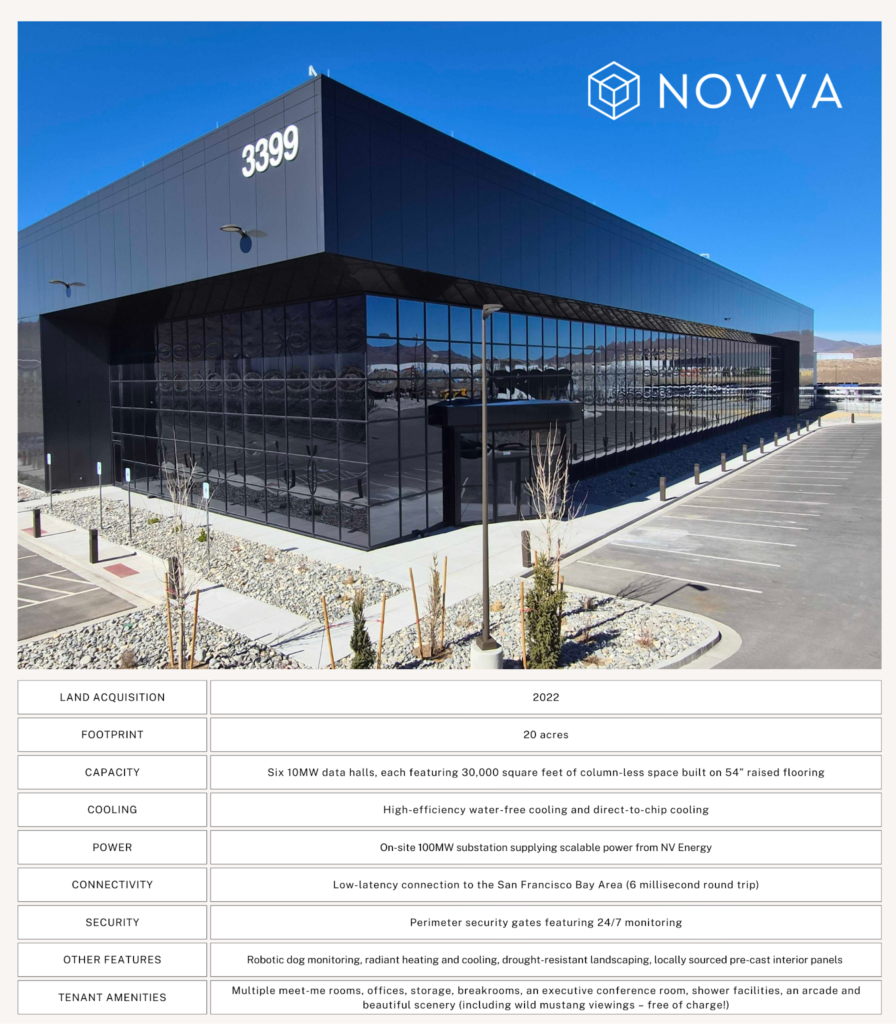
We built a 100-megawatt substation engineered to support 60 megawatts of critical IT load at full buildout, but we agreed to ramp in phases. We have 40 megawatts currently, and we’ll continue to increase capacity in 10- to 20-megawatt increments over several years as allocations become available. In constrained markets, that kind of disciplined growth isn’t a limitation; it’s responsible stewardship. By working cooperatively with the utility and aligning our clients’ timelines with grid expansion, we’ve created a model that prioritizes safety, reliability, and long-term scalability over short-term acceleration.
Novva Tahoe Reno sits on just 20 acres, but from the outset, I viewed it as an opportunity to challenge ourselves on density. Delivering 60 megawatts of capacity on a parcel that also accommodates a full substation, parking, fire lanes, and all required infrastructure was, for us, a deliberate experiment in highly efficient design. In the Mountain West, few facilities operate at that kind of power density within such a compact footprint. We set out to prove that we could maximize every acre without compromising resilience or scalability. It’s a very tight fit by design, and that intensity reflects our goal of building one of the most efficient, high-density campuses in the region while still preserving room for future expansion.
Results and Power Usage Effectiveness:
•Novva’s space proprietary energy delivery architecture, which is 100% concurrently maintainable, features distributed redundant power distribution and a software-controlled independent bus switch from transformer to lithium-ion uninterruptible power supply, as well as SCR-equipped diesel generators for each leg of power.
•Novva Tahoe Reno has a PUE of approximately 1.25 — a very strong result for a large wholesale facility, particularly given high density and cooling demands.
Water-Free and Direct-to-Chip Cooling Capabilities
In the Mountain West, drought conditions are cyclical and persistent, which is why designing for low water consumption was non-negotiable.
While much of the industry continues to rely on water-intensive evaporative cooling and economization, we took a different approach. We engineered the facility to support direct-to-chip liquid cooling for high-density AI workloads while also maintaining highly efficient air-cooling capabilities. The facility is also outfitted with a signature technology of any Novva facility: our proprietary water-free cooling system featuring a recyclable polypropylene chilled water pipe to cut down on water demand from nearby Lake Tahoe and the Truckee River.
Flexibility is equally central to our philosophy. Today’s AI environments often trend toward 70 percent liquid cooling and 30 percent air, but we deliberately built the data center to “teeter-totter” in either direction—50% liquid/50% air if needed, or shifting over time as rack densities and chip architectures evolve. It can change with the times. The modular hall architecture, high-density electrical design, and mixed cooling capabilities ensure that as GPUs become more powerful, power per rack increases, and new thermal management technologies emerge, the building will adapt rather than become obsolete. We design our campuses with a 30- to 40-year life in mind. That means anticipating change, lowering the carbon footprint over time, and ensuring the facility can efficiently support future workloads we cannot yet fully predict. Cooling efficiency is never about a single decision; it reflects site selection, altitude, humidity, building design, operating temperatures, compute density, and the technologies deployed. Our role as operators is to harmonize those variables into a system that performs responsibly, both environmentally and economically, for decades.
Water Usage Effectiveness and Efficiency Results:
•36 chillers at full buildout that will save 1.8 million gallons of water per day versus traditional evaporative systems
•The site’s higher altitude and dry climate allow for more efficient ambient cooling, which we are able to use for approximately 65-70% of the year. The other 30-35% of the time, we operate in a hybrid system, using ambient air and the water-free cooling system together.
•As a result of employing our water-free system across each of our facilities, we saved an average of 11,150,000 gallons of water per day in 2025
Performance, Modularity, and Future-Ready Design
AI and machine learning workloads have permanently changed the density equation. Where traditional facilities designed for 5–15 kW per rack, AI deployments now routinely exceed 20–30 kW, and 40 kW+ is on the horizon.
We engineered the facility’s power delivery, heat rejection, under-floor infrastructure, and structural load capacity to anticipate these elevated demands from the outset.
That philosophy is reflected most clearly in our data hall architecture. The campus features six column-less data halls, each offering approximately 30,000 square feet of open space and 54 inches of raised flooring. This design gives tenants a blank, structurally unobstructed canvas that is ideal for evolving rack configurations, diverse power densities, and rapidly changing AI hardware. The raised-floor depth supports flexible air distribution and liquid piping strategies, enabling us to accommodate everything from traditional air-cooled cabinets to high-density liquid-assisted racks without structural redesign.
Equally important is our modular approach. Rather than forcing customers to build out full capacity on day one, the campus is segmented into modular data halls that allow tenants to scale in alignment with actual consumption. This enables better capital efficiency, optimized power utilization, and phased deployment strategies that mirror the way AI clusters are typically expanded. Longevity was non-negotiable: the entire facility is engineered for a 30- to 40-year lifespan, with the structural, electrical and cooling systems all designed to support shifting GPU/CPU mixes, emerging cooling technologies, and future power distribution paradigms.
Results in performance and capacity utilization:
•54″ raised flooring and a total of six 10MW data halls, which each feature approximately 30,000 feet of column-less space to maximize available square footage for tenants.
•Proximity to the Bay Area and low-latency fiber (~6 ms RTT) gives the facility a strategic edge for latency-sensitive AI training or inference pipelines that may integrate with West Coast cloud or edge networks.
•Initial occupancy is ~50 % (30 MW of 60 MW IT load committed). With the 100 MW substation in place, the facility has significant headroom for future phases and tenant demand.
Architectural Aesthetic and Our Homage to Reno
Finally, while performance and sustainability anchored the project, there is no rule that a data center has to look like an anonymous concrete bunker.
So we raised the aesthetic bar, too.
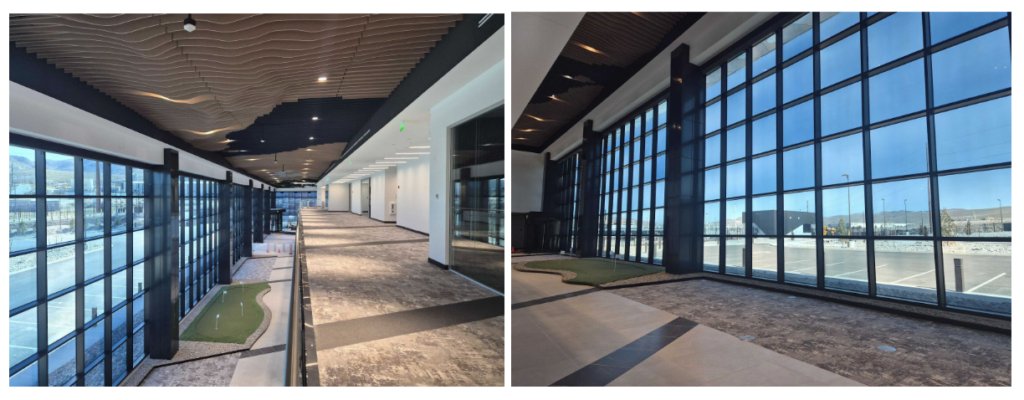
Clean architectural lines, strategic glazing, and carefully considered interior finishes create a facility that feels purposeful rather than purely industrial.
We also wanted the campus to reflect its surroundings. One of my favorite details is the ceiling installation, which is a topographical representation of the surrounding mountain range painted across the structural beams. It’s a subtle nod to Northern Nevada’s landscape, but it changes the experience of the space.
These thoughtful touches reinforce our belief that mission-critical infrastructure doesn’t have to be sterile. It can honor regional identity, create a sense of place, and make customers feel at home while still delivering world-class performance beneath the surface.
7 Lessons Learned & Advice for Similar Projects
Tahoe Reno was an ambitious, high-density, next-generation build — and like any ambitious project, it came with its share of hard-earned insights. If you’re planning a similar campus, I’d like to close this chapter with seven key lessons we learned in the field that may save you time, capital, and a few sleepless nights.
•1 – Site selection and location strategy: Climate, flood risk, seismic exposure, and adjacent industries all affect long-term carbon and capital impact. Linking sustainability with resiliency and cost should all be of equal consideration.
•2 – Secure utility easements early: Power conveyance and transmission approvals can create significant risk if not locked in early.
•3 – Design for density and flexibility: Build for where AI workloads are going — not where they are today.
•4 – Be water-sensitive: Closed-loop and water-free systems are critical in semi-arid climates.
•5 – Be realistic about local labor competition, and schedule accordingly: When data center builds cluster regionally, labor competition abounds. Early procurement, independent contractors, and strong labor planning mitigate this risk.
•6 – Leverage location advantages: Reno’s industrial zoning, low residential adjacency, strong utility infrastructure, fiber infrastructure, and low geologic risk make it an attractive location. Still, developers must evaluate hidden risks: topography/grading, drainage, site remediation, and permitting variances. Novva’s site had good drainage and a level grade, which made a huge difference in a city nicknamed “the birthplace of rocks.”
•7 – Monitor and benchmark performance continuously: Efficiency targets only matter if they are measured, benchmarked, and improved over time.

Author: Courtney Burrows
Courtney Burrows is the Executive Editor of Greener Data and Executive Vice President of Marketing and Sustainability at JSA, where she leads content strategy across PR, marketing, and media initiatives for the global digital infrastructure industry. With more than 20 years of experience — and over a decade dedicated to data centers — she curates expert insights focused on data center sustainability, innovation, and the evolving demands of an AI-driven world.