


Linda Lescuyer, Data4 – Mary Allen, InsightaaS & JSA
This chapter is an excerpt from Greener Data: Volume Three, launched on Earth Day 2026. Featuring perspectives from 75+ sustainability leaders across the digital infrastructure ecosystem, the full book is available now on Amazon.
“Energy cannot be created or destroyed, it can only be changed from one form to another.” ~Albert Einstein
Background
Headquartered in France, the Data4 Group builds and operates colocation data centers in six European markets, including France, Italy, Poland, Spain, Greece, and Germany, where it counts telecoms, cloud providers, and IT dedicated companies as clients. The first pillar in Data4’s strategy to future proof the organization is innovation to enhance resilience, efficiency, and sustainability. A compelling example of this innovation is found in Data4’s bio-circular data center project, a unique new approach to resource use that offers strong potential to drive data center sustainability and competitiveness.
The Challenge
In the data center, power consumed is transformed into heat at a 1:1 ratio; one kilowatt hour of electricity consumed produces one kilowatt of thermal heat. If reused, this heat represents a huge untapped source of energy. The data center sector currently consumes approximately two percent of global energy and is on track to double consumption by 2030.1
Today, this energy is routinely ejected from the facility as waste heat. In Europe, less than 20 percent of thermal energy is collected and reused due to technical and market complexity involved in the process. When heat from data centers is injected into district heat networks, it displaces existing production, creating additional competition for established producers who are experiencing decreased demand due to more stringent regulation on heat efficiency in buildings. Developing the heat networks required to integrate data center energy is a challenging proposition in itself, involving heat producers and local authorities, and the economic viability is not always certain. Cost effectiveness is dependent on the density of the heat network; if the data center is located far from the urban core where heat is consumed (ex, in residential or commercial buildings), the economics are more precarious.
Data4 is conversant with the issues that emerge in heat recovery and reuse. The company now has two projects underway in Paris and Germany for the integration of data center thermal energy into district heating – in areas under development that are viable as new energy systems are being built. But the company continues to seek out additional, innovative means to reuse heat energy and transform it into useful resources for local communities. Drawing on principles of the circular economy, it recently launched a biomass pilot that uses algae as a new medium for storing heat energy from the data center.
Project Origins
The Data4 pilot project has origins in partnerships within the local community. In 2024, the ABIOMAS Innovation Chair was created by the Conseil Départemental de l’Essonne within the Fondation Université Paris-Saclay, with a mandate to explore and incubate solutions to augment the capacity of biomass, as a new opportunity in the circular economy. The bio-circular data center project that emerged would be run by a multi-disciplinary team composed of specialists in biomass, digital and AI platforms, physics, and chemistry from Centrale-Supélec, AgroParisTech, INRAE, the ICMMO Laboratory at the University of Paris-Saclay, and Blue Planet Ecosystems, an Austrian start-up with experience in fish farms and phytoplankton (algae) production. With its Marcoussis data center located in the Essonne region, Data4 was invited to participate as sponsor of the Innovation Chair, and to provide its campus as a site for research and the project pilot. 2
How Does It Work?
The Data4 pilot uses heat captured from the data center and exchanged through convection and conduction systems to support the growth of micro algae, which is used by the food and cosmetics industries, pharmacology, and even to produce biofuel. Fresh air is blown into the server room and warmed to 30 degrees, this warm air heats a closed water loop, which transfers the heat to the roof of the building to warm the seaweed-based liquid solution. The plant is chlorella, an algae genus that is common in European waters and poses no environmental risk. It is also a plant that thrives in environments that are 25 – 30 degrees C, a temperature range that is common to most data centers. Since algae growth also relies on photosynthesis and CO2, it is planted in transparent tubes for exposure to light.
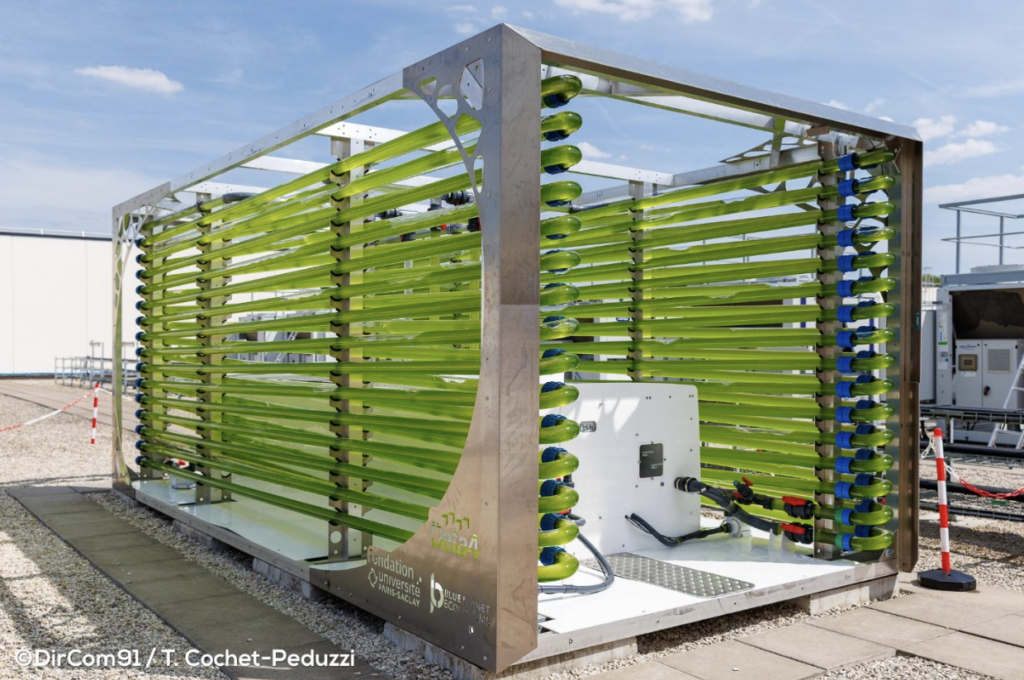
Data4 algae tube module.
Project Parameters
Through its four-year partnership with Fondation Université Paris-Saclay, Data4 has defined the prototype and now has proof of concept with the LARA module in place. Depending on final results of the pilot, the company intends to scale the algae project through deployment at data center campuses across Europe. It hopes, ultimately, to inspire other kinds of industries to develop similar solutions for the production of renewable energy.
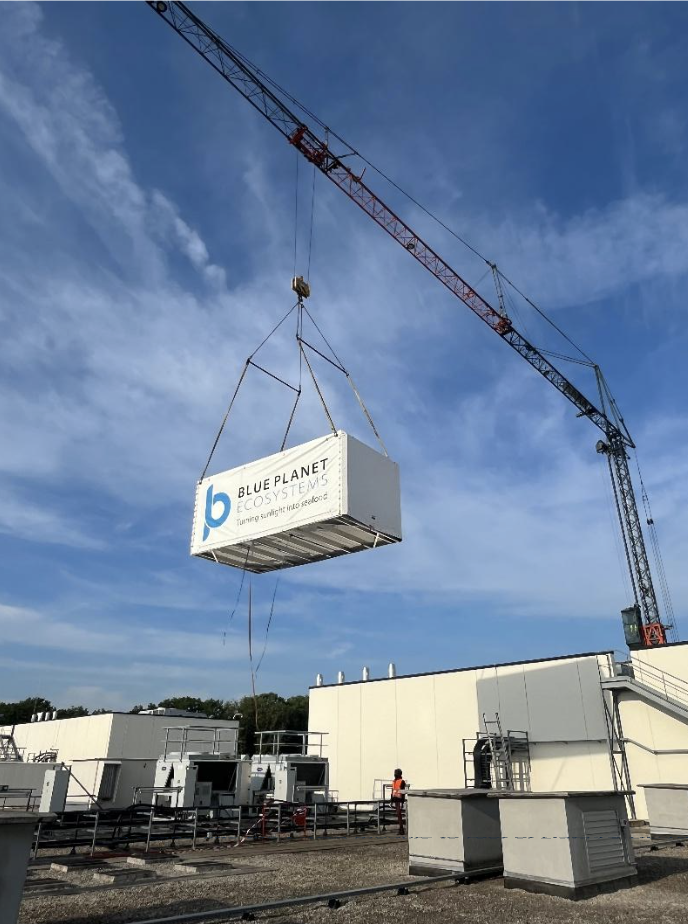
Scale of the model has limits, however, due to sensitivity around land use. Data centers already use land, and rather than compete with agriculture and other sectors for more land, Data4 is looking to maximize production on sites where data centers are now or will be built. Through algae plantations on facility roofs and building facades, it anticipates the reuse of between 20-30 percent of the heat generated by the data center.
Another constraint lies in the security requirements of critical facilities. Operational protocols that are in place to ensure safety, data confidentiality, and reliability prohibit the free movement of workers back and forth in the data center perimeter. But algae must be collected every eight hours. Going forward, Data4 anticipates installing the algae tubes along the walls of the data center, outside the technical perimeter of the facility, rather than on the roof. In this kind of implementation, the algae will settle at the base of the wall, where it can be separated from the growing medium through a centrifugal system. This setup will make the process more autonomous and thereby mitigate any risk associated with human interactions.
Measuring Success
Data4 has developed a hierarchy of use cases for the algae grown using data center heat. An obvious application for recovered heat is conversion into electricity, a commodity for which data centers have clear appetite. Data4 anticipates that the algae biomass could be fed into district waste recovery plants that convert vegetable matter to energy – or ultimately to onsite conversion plants to create methane for consumption by data center generators/turbines. Currently, yields on this kind of conversion process are low (approximately 20 percent), however, and the economic efficiency of the model is limited.
But high-quality algae is the raw material in other applications that offer substantial returns. Today, it typically grows only in nature and there are no algae farmers. As a result, algae commands a high price – 100 euros per kilogram in the marketplace; even if this price was halved, the company could profitably sell to the cosmetics or pharmacology industries, while at the same time devoting any surplus to the creation of new biofuel, methane, or even plastic resources. High market prices reinforce a strong business case for directing data center heat energy to algae production.
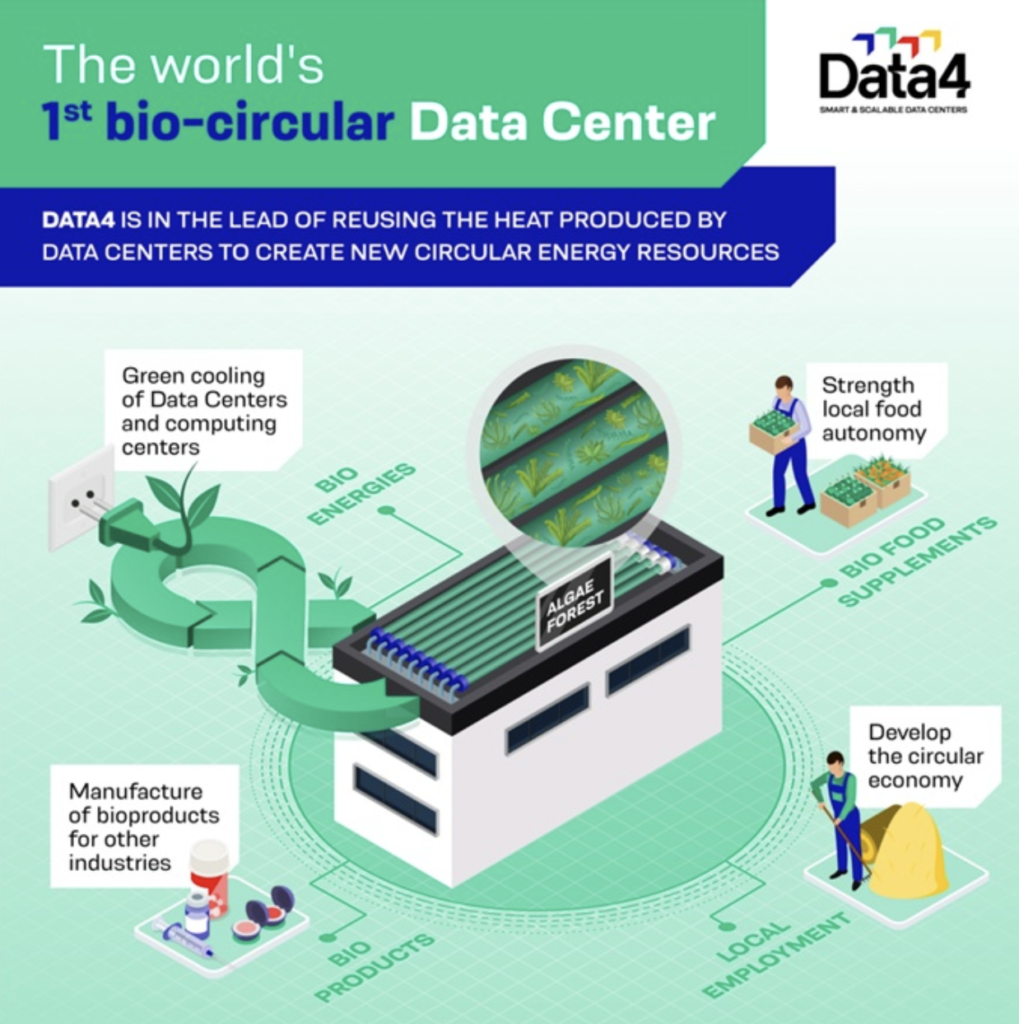
Through the Marcoussis pilot, Data4 has established that it is possible to grow 20 kilograms of algae per day – the algae reproduces itself every eight hours. The industrial production of chlorella algae across data centers may deflate prices, but this would create opportunity for the development of new applications and new markets. This is Data4’s focus as it enters stage two of the bio-circular data center project. The most efficient use of algae is likely food production and electricity production is less so; however, the company envisions a tier of applications that would maximize use of the product through its lifecycle. Data4 predicts that 100 percent of production will find a market.
In addition to algae production for various markets, the implementation also serves as an important mechanism for carbon capture. Algae production relies on the use of heat but also has photosynthetic ability to absorb CO2 and convert it into biomass. Researchers have found carbon capture efficiencies as high as 90 percent,3 and stressed the potential for algae to serve as a valuable tool in climate change mitigation. Due to rapid rates of reproduction, algae absorbs CO2 more efficiently and exhibits higher capture rates; in commercial applications, researchers have found that for every ton of algae produced, nearly two tons of carbon can be captured.4 According to Patrick Duvaut, Vice-President of the Université Paris-Saclay and President of the Fondation Paris-Saclay, the feasibility study conducted in partnership with Blue Planet Ecosystems at Data4 shows that the efficiency of carbon capture through the algae method is close to 20 times that of a tree (with an equivalent surface area).5
This kind of metric is key to an overarching Data4 goal, which is to give back to the community to encourage acceptance of data centers within local regions. The algae module deployment involves teams of scientific experts who can demonstrate positive carbon impact, but has also engaged construction companies, equipment suppliers, as well as an energy company, helping to ensure that the data center serves as a contributing member to regional ecosystems.
RESOURCES
1. IEA. Energy and AI. Executive Summary. https://www.iea.org/reports/energy-and-ai/executive-summary
2. The University of Paris-Saclay and Data4 launch a pilot project to create the world’s first bio-circular data center.
https://www.data4group.com/en/news-data4/the-university-of-paris-saclay-and-data4-
3. Richard Sayre. Microalgae: The Potential for Carbon Capture. BioScience, v. 60, no. 9, October 2010. https://doi.org/10.1525/bio.2010.60.9.9
4. Guihe Li and Jia Yao. A Review of Algae-Based Carbon Capture, Utilization, and Storage (Algae-Based CCUS). MDPI. v.4, no. 4. December 2024. https://www.mdpi.com/2673-5628/4/4/24
5. The University of Paris-Saclay and Data4 launch a pilot project to create the world’s first bio-circular data center.
https://www.data4group.com/en/news-data4/the-university-of-paris-saclay-and-data4-

Author: Courtney Burrows
Courtney Burrows is the Executive Editor of Greener Data and Executive Vice President of Marketing and Sustainability at JSA, where she leads content strategy across PR, marketing, and media initiatives for the global digital infrastructure industry. With more than 20 years of experience — and over a decade dedicated to data centers — she curates expert insights focused on data center sustainability, innovation, and the evolving demands of an AI-driven world.